Best Epson EcoTank Printer 2026
by Remington May
Which Epson EcoTank printer is actually worth your money in 2026 — and does the model everyone recommends still hold up? With seven models ranging from bare-bones home printers to wide-format workhorses, picking the right one isn't obvious. If you're in a hurry, the Epson EcoTank ET-2800 hits the sweet spot for most households: simple, reliable, and genuinely affordable to run. But depending on your needs, another model might serve you better — and that's exactly what this guide breaks down.
Epson's EcoTank line solves the single most frustrating thing about owning an inkjet printer: the constant cost of replacement cartridges. Instead of tiny cartridges that run dry after a few hundred pages, EcoTank printers use large, refillable ink tanks. You fill them from bottles. The savings add up fast — Epson claims you can save up to 90% on ink costs compared to traditional cartridge-based printers. If you've ever felt robbed paying $40 for a cartridge that prints 200 pages, you already understand the appeal.
This review covers all seven major EcoTank models available in 2026, from the entry-level ET-2400 to the professional-grade ET-15000. Whether you're printing homework, invoices, or large-format graphics, there's a model here for you. We've also put together a buying guide below to help you match the right printer to your actual usage. If you're also comparing ink costs across brands, check out our roundup of the best printers with the cheapest ink cartridges for broader context. Now, let's get into it.

Contents
- Editor's Recommendation: Top Picks of 2026
- In-Depth Reviews
- Epson EcoTank ET-2760 — Best All-Around Home Printer
- Epson EcoTank ET-2800 — Best for Basic Home Use
- Epson EcoTank ET-3760 — Best for Home Office
- Epson EcoTank ET-2720 — Best Budget Family Printer
- Epson EcoTank ET-2803 — Best for AirPrint Users
- Epson EcoTank ET-15000 — Best for Wide-Format Printing
- Epson EcoTank ET-2400 — Best for Everyday Documents
- Buying Guide
- Common Questions
- Next Steps
Editor's Recommendation: Top Picks of 2026
- #PreviewProductRating
- Bestseller No. 1
 Rating:

- Bestseller No. 2
 Rating:
 - Bestseller No. 3
 Rating:
 - Bestseller No. 4
 Rating:
 - Bestseller No. 5
 Rating:
 - Bestseller No. 6
 Rating:
 - Bestseller No. 7
 Rating:
In-Depth Reviews
1. Epson EcoTank ET-2760 — Best All-Around Home Printer
The ET-2760 is the printer that put EcoTank on the map for home users, and in 2026 it still earns its reputation. It prints, scans, and copies — all without ever touching an ink cartridge. The high-capacity tanks come pre-filled with enough ink to print up to 7,500 pages in black and 6,000 in color, which Epson equates to roughly 90 individual cartridges. That's a serious amount of printing before you need to reach for a refill bottle.
Setup is straightforward, and the color LCD display makes navigation easy even if you're not particularly tech-savvy. Auto-duplex printing (two-sided printing without flipping pages manually) is a feature you'll use more than you expect — it cuts paper consumption noticeably over time. Print quality on documents is sharp and consistent, and photos come out decent for everyday use, though not gallery-worthy. If you're looking for dedicated photo output, something like the printers in our best photo printers under $200 guide may be a better fit.
Where the ET-2760 really shines is its combination of features at a price that quickly pays for itself in ink savings. If you print more than 100 pages a month, the math works heavily in your favor compared to any cartridge-based printer.
Pros:
- Massive ink capacity — up to 7,500 black pages per refill set
- Auto-duplex printing included
- Color LCD display for easy navigation
- High-resolution flatbed scanner
- EcoFit bottles make refilling clean and simple
Cons:
- Photo print quality is average compared to dedicated photo printers
- Slower print speed than laser alternatives
- Larger footprint than basic cartridge printers
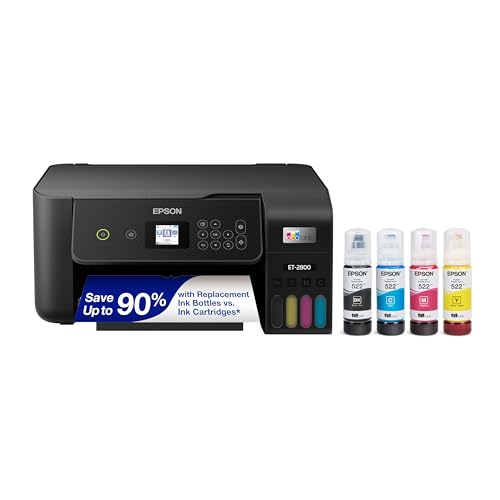
2. Epson EcoTank ET-2800 — Best for Basic Home Use
If you want the EcoTank experience without paying for features you'll never use, the ET-2800 is your printer. It's Epson's most accessible entry point into cartridge-free printing, designed specifically for households that need reliable everyday output without complexity. It prints, scans, and copies — and that's genuinely all most people need from a home printer.
The ET-2800 uses Epson's Micro Piezo Heat-Free Technology, which means the printhead doesn't use heat to fire ink droplets. This approach is gentler on ink and tends to produce more consistent results over the printer's lifespan. Print speeds reach up to 10 pages per minute, which is perfectly adequate for homework assignments, forms, and family documents. The color prints are vivid and detailed enough for anything short of professional photography.
One thing to keep in mind: the ET-2800 is a simpler machine than the ET-2760. It lacks auto-duplex printing and the LCD display is more basic. But if those features aren't important to you, you're getting a rock-solid EcoTank printer at a lower price point. Ink yields are strong — up to 4,500 pages black and 7,500 color per bottle set, equivalent to about 80 individual cartridges.
Pros:
- Most affordable EcoTank entry point
- Micro Piezo Heat-Free Technology for consistent print quality
- Up to 10 pages per minute print speed
- Ink yield equivalent to ~80 cartridges per bottle set
- Compact and easy to set up
Cons:
- No auto-duplex printing
- More limited display compared to other EcoTank models
- Black page yield lower than ET-2760 (4,500 vs 7,500 pages)
3. Epson EcoTank ET-3760 — Best for Home Office
The ET-3760 steps up from the entry-level models in meaningful ways, adding Ethernet connectivity on top of wireless — a feature that matters a lot if you're running a home office with multiple devices or a wired network setup. It's positioned between the home-focused ET-2760 and the professional ET-15000, and for a lot of small office or heavy home users, that middle ground is the sweet spot.
Ink costs are where the ET-3760 makes a strong argument for itself. Epson puts the per-page color cost at about 1 cent per ISO page versus roughly 20 cents with standard cartridges — a dramatic difference that adds up to real savings if you print regularly. Each replacement ink set delivers up to 7,500 pages black and 6,000 color, and the set covers about two years of typical usage. Fewer trips to the store, less packaging waste, more predictable costs.
The ET-3760 also supports auto-duplex printing and includes a higher-capacity paper tray than the entry-level models. If you're sharing the printer across multiple computers in a household or small office, the Ethernet port means you won't deal with the wireless dropouts that occasionally frustrate users of Wi-Fi-only models.
Pros:
- Ethernet connectivity for wired network setups
- Extremely low per-page cost (~1 cent/color page)
- Up to 7,500 black / 6,000 color pages per ink set
- Auto-duplex printing
- Roughly 2 years of ink per replacement set
Cons:
- Higher upfront cost than basic EcoTank models
- Larger and heavier than the ET-2800 or ET-2760
- No fax functionality (see ET-15000 for that)
4. Epson EcoTank ET-2720 — Best Budget Family Printer
The ET-2720 in white is essentially the family-friendly face of the EcoTank lineup. It was designed from the ground up to be approachable — easy to set up, easy to refill, and easy to use day-to-day. If your household involves kids printing school projects or you just need a dependable printer that isn't going to frustrate you, this is a strong candidate.
Like other EcoTank models, it uses Epson's EcoFit ink bottles, which are shaped to prevent messy spills during refills. The color display makes it easier for anyone in the house to operate without calling for technical support. Ink yields are solid — up to 4,500 pages black and 7,500 pages color per bottle set, equivalent to roughly 90 standard cartridges. For casual to moderate printing needs, you could go over a year before needing to buy more ink.
The ET-2720 doesn't have auto-duplex printing, which is a trade-off worth knowing about. But its print quality for everyday documents and occasional photos is genuinely good, and the wireless setup works reliably with both Windows and Mac systems. For a family printer that keeps costs low without a lot of fuss, it's a solid pick.
Pros:
- Beginner-friendly design with color display
- EcoFit bottles minimize ink spills during refills
- Up to 7,500 color pages per bottle set
- High-resolution flatbed scanner included
- Works with Windows and Mac wirelessly
Cons:
- No automatic duplex printing
- Print speed is modest compared to office-grade printers
- Older model — some connectivity features less advanced than ET-2800
5. Epson EcoTank ET-2803 — Best for AirPrint Users
If you're deep in the Apple ecosystem — iPhone, iPad, MacBook — the ET-2803 deserves a serious look. AirPrint support means you can send a print job directly from your iPhone without installing any drivers or apps. It just works. That seamless experience is genuinely useful if you're regularly printing documents, boarding passes, or recipes from your phone.
Beyond AirPrint, the ET-2803 carries the same core EcoTank strengths: cartridge-free printing, up to 4,500 black and 7,500 color pages per bottle set (equivalent to about 80 cartridges), and up to two years of ink in the box. The "stress-free printing" tagline isn't just marketing — the large ink tanks mean you're unlikely to hit an "out of ink" moment in the middle of something important.
Scan and copy functionality is included, and wireless connectivity is straightforward. It's worth noting that the ET-2803 sits at a similar level to the ET-2800 in terms of feature depth — the key differentiator is AirPrint. If you're primarily a Windows user, the ET-2800 may offer similar value at a comparable or lower price point. But for Mac and iOS households, this model earns its place.
Pros:
- AirPrint support for easy printing from iPhone and iPad
- Up to 2 years of ink included in the box
- Up to 7,500 color pages per bottle set
- Cartridge-free design with no ongoing cartridge costs
- Scan and copy functionality included
Cons:
- Similar feature set to ET-2800, mainly differentiates on AirPrint
- Black page yield (4,500) lower than higher-tier models
- No auto-duplex printing
6. Epson EcoTank ET-15000 — Best for Wide-Format Printing
The ET-15000 is a different animal from everything else on this list. It can print up to 13 × 19 inches — a format sometimes called Super B or tabloid-plus. If you're printing large flyers, architectural drawings, art prints, or marketing materials in-house, this is the only EcoTank model that handles it. No other printer in this lineup comes close to its output size.
Beyond wide-format capability, the ET-15000 is a fully featured all-in-one with print, scan, copy, and fax. It includes both Ethernet and wireless connectivity, plus USB — so it integrates cleanly into almost any office or studio setup. The fax feature may feel dated, but it's still a requirement in certain professional contexts, and having it built in saves you the hassle of a separate fax machine. Built-in wireless (802.11b/g/n) lets you print from virtually anywhere on your network.
The trade-off is cost — both upfront and in size. This is a large, heavy printer. It's not something you slide under a desk. But if wide-format printing is part of your workflow, the EcoTank ink savings make it dramatically cheaper to operate than comparable wide-format inkjet alternatives. For photographers or designers who also want low-cost everyday printing, this could genuinely replace multiple machines. If you need even more specialized output, you might also explore our guide to the best pigment ink printers for archival-quality results.
Pros:
- Prints up to 13 × 19 inches — unique in the EcoTank lineup
- Includes fax functionality
- Ethernet, wireless, and USB connectivity
- Full all-in-one: print, scan, copy, fax
- EcoTank ink savings apply to wide-format output
Cons:
- Significantly higher upfront cost than other EcoTank models
- Large physical footprint — needs dedicated space
- Overkill for standard home printing needs
7. Epson EcoTank ET-2400 — Best for Everyday Documents
The ET-2400 is Epson's latest entry-level EcoTank, and it comes with a few small but meaningful upgrades over older base models. The rear-feed input tray holds up to 100 sheets — a practical improvement for anyone who has ever had to babysit a printer through a long print job. It also supports both wired and wireless connectivity, giving you flexibility in how you integrate it into your workspace.
Like all EcoTank printers, the ET-2400 is cartridge-free. Each ink bottle set is equivalent to about 80 individual cartridges and delivers up to 4,500 black pages and 7,500 color pages. The savings over time are substantial. For everyday document printing — reports, invoices, school assignments, receipts — this printer delivers exactly what you need without unnecessary complexity or cost.
It's not a powerhouse. It doesn't have auto-duplex or a high-resolution display. But for someone stepping into EcoTank for the first time and wanting something current and capable without a big investment, the ET-2400 is a smart, modern choice. The print, copy, and scan combination covers essentially every printing task a home or small office user is likely to encounter day to day.
Pros:
- 100-sheet rear-feed paper tray
- Both wired and wireless connectivity
- Up to 7,500 color pages per bottle set
- Current-generation model with up-to-date software support
- Print, scan, and copy in one unit
Cons:
- No auto-duplex printing
- 4,500-page black yield is lower than higher-tier models
- Basic display — less intuitive than models with a color LCD
Buying Guide: How to Choose the Best Epson EcoTank Printer
With seven models on the table, the decision comes down to a handful of key questions. Answer these honestly and the right model usually becomes clear quickly.
1. How Much Do You Print Per Month?
This single question probably matters more than any other. EcoTank printers have a higher upfront cost than cheap cartridge printers — you're paying for the ink tank system and the large initial ink supply. That upfront cost pays off faster the more you print.
- Light use (under 50 pages/month): The ET-2800 or ET-2400 is more than enough. You may even find a cheaper cartridge printer makes financial sense if you print very rarely.
- Moderate use (50–300 pages/month): The ET-2760 or ET-2803 hits the sweet spot — enough features, strong ink yields, solid savings.
- Heavy use (300+ pages/month): The ET-3760 with Ethernet connectivity and maximum ink yield is the logical choice. The per-page cost of ~1 cent/color page makes a real difference at volume.
2. Do You Need a Scanner?
All seven models reviewed here include a flatbed scanner and copier. So if scanning is part of your workflow, you're covered regardless of which EcoTank you choose. That said, scanner quality varies between models. If scanning is critical — say, you're digitizing documents regularly — look at dedicated scanners reviewed in our best document scanner for home guide alongside your printer choice. For most users, the built-in scanner handles everyday tasks without issue.
3. What Connectivity Do You Need?
Most EcoTank models support Wi-Fi. But there are meaningful differences worth considering:
- Wi-Fi only: ET-2800, ET-2760, ET-2720, ET-2803 — sufficient for home users
- Wi-Fi + Ethernet: ET-3760, ET-15000, ET-2400 — better for shared office setups or wired networks
- AirPrint: ET-2803 — the standout choice for Apple device users
- Fax: ET-15000 only — relevant for certain professional environments
If you're printing from an iPhone or iPad daily, AirPrint support on the ET-2803 removes friction you didn't know you had until it's gone. Understanding how inkjet printing works can also help you appreciate why connectivity and driver compatibility matter for consistent output quality.
4. Do You Have Special Format or Feature Requirements?
For most home users, standard letter and legal sizes are all you'll ever need. But if you're a designer, photographer, or small business owner printing posters, large flyers, or wide-format graphics in 2026, the ET-15000 is the only EcoTank that prints up to 13 × 19 inches. No other model on this list can touch that. Similarly, if fax is a hard requirement for your business, the ET-15000 is the only option here that includes it. Everyone else can safely ignore those features and save accordingly.
Common Questions
How long does EcoTank ink last?
It depends on the model and how much you print. For most EcoTank printers, one set of replacement ink bottles lasts up to 2 years under typical home usage. Models like the ET-2760 and ET-3760 deliver up to 7,500 black pages and 6,000 color pages per set. Heavy users will go through ink faster, but even then, the per-page cost stays far below cartridge printers.
Is EcoTank ink expensive to refill?
No — that's the whole point. Replacement ink bottles for EcoTank printers cost significantly less than traditional cartridges and print far more pages. Epson estimates you save up to 90% on ink costs versus cartridge-based printers. Over the life of the printer, most moderate-to-heavy users recover the higher upfront cost within the first year or two.
Can EcoTank printers print photos?
Yes, though results vary by model and paper. EcoTank printers use dye-based ink, which produces vibrant colors suitable for everyday photo printing. For casual snapshots and family photos, the quality is genuinely good. For professional or archival photo output, you may want a dedicated photo printer with pigment-based inks, which offer better fade resistance. If photos are a priority, our guides to the best 4×6 photo printers offer more targeted options.
What's the difference between the ET-2800 and ET-2803?
The primary difference is AirPrint support. The ET-2803 includes AirPrint, which lets you print directly from iPhone, iPad, and Mac without installing drivers. The ET-2800 is otherwise very similar in capability and ink yields. If you're an Apple household, the ET-2803 is worth the small price difference. Windows users will find either model equally functional.
Do Epson EcoTank printers work with third-party ink?
Technically yes — the tanks are refillable and not locked to a specific cartridge chip. However, Epson strongly recommends using genuine EcoTank ink bottles to ensure print quality and protect your printhead warranty. Third-party inks vary widely in quality and can cause clogging or color accuracy issues over time. For the best long-term performance, stick with Epson's own ink bottles.
Which EcoTank model is best for a small business in 2026?
For most small businesses, the ET-3760 strikes the right balance — it has Ethernet connectivity for shared network printing, auto-duplex for paper savings, and extremely low per-page costs at about 1 cent per color page. If you need wide-format output or fax, the ET-15000 is the step up. For a truly minimal office setup where fax isn't required and volume is moderate, the ET-2760 handles business printing reliably at a lower upfront cost.
Buy on Walmart
- Epson EcoTank ET-2760 Wireless Color All-in-One Cartridge-Fr — Walmart Link
- Epson EcoTank ET-2800 Wireless Color All-in-One Cartridge-Fr — Walmart Link
- Epson EcoTank ET-3760 Wireless Color All-in-One Cartridge-Fr — Walmart Link
- Epson EcoTank ET-2720 Wireless Color All-in-One Supertank Pr — Walmart Link
- Epson EcoTank ET-2803 Wireless Color All-in-One Cartridge-Fr — Walmart Link
- Epson EcoTank ET-15000 Wireless Color All-in-One Supertank P — Walmart Link
- Epson EcoTank ET-2400 Wireless Color All-in-One Cartridge-Fr — Walmart Link
Buy on eBay
- Epson EcoTank ET-2760 Wireless Color All-in-One Cartridge-Fr — eBay Link
- Epson EcoTank ET-2800 Wireless Color All-in-One Cartridge-Fr — eBay Link
- Epson EcoTank ET-3760 Wireless Color All-in-One Cartridge-Fr — eBay Link
- Epson EcoTank ET-2720 Wireless Color All-in-One Supertank Pr — eBay Link
- Epson EcoTank ET-2803 Wireless Color All-in-One Cartridge-Fr — eBay Link
- Epson EcoTank ET-15000 Wireless Color All-in-One Supertank P — eBay Link
- Epson EcoTank ET-2400 Wireless Color All-in-One Cartridge-Fr — eBay Link
Next Steps
- Check current prices on Amazon for your top one or two models — EcoTank printer prices shift frequently, and deals appear without warning.
- Compare your monthly print volume against each model's ink yield to calculate your estimated annual ink cost and see how quickly the upfront price pays off.
- Verify connectivity compatibility with your existing devices — confirm AirPrint if you're on Apple, or Ethernet support if you need wired network printing.
- Read recent buyer reviews on Amazon for your shortlisted model, filtering for reviews from the past 6 months to catch any reliability issues with current production batches.
- Browse the full buying guide at /buying-guide/ if you're still comparing EcoTank against other printer categories — laser, photo, or wide-format — before making a final decision.



About Remington May
Remington May is a technology writer and digital product reviewer with a focus on consumer electronics, software, and the everyday tech that shapes how people work and live. She has spent years evaluating smartphones, laptops, smart home devices, and digital tools — approaching each product from the perspective of a practical user rather than a spec-sheet enthusiast. At Pinwords, she covers tech buying guides, product reviews, smartphone and laptop comparisons, and practical how-to guides for getting more out of your devices.
Check for FREE Gifts. Or latest free books from our best messages.
Remove Ad block to reveal all the secrets. Once done, hit a button below