Best Shipping Label Printer For eBay 2026
by Remington May
Roughly 140 million active buyers shop on eBay every month, and each package you ship is a direct reflection of your seller reputation. If you're printing labels on a standard inkjet and taping them to boxes, you're operating at a disadvantage — a dedicated 4×6 thermal label printer prints a crisp, scannable label in under two seconds, no ink, no scissors, no waste. In 2026, these printers have become a non-negotiable tool for any eBay seller moving more than a handful of packages per week, and the good news is that quality options exist at nearly every price point.
The challenge isn't finding a thermal label printer — it's finding the right one for your specific setup. Do you need wireless printing from your phone between shipments? Are you running a Windows desktop or a Mac? Do you sell across multiple platforms beyond eBay? The answers to those questions determine which printer actually saves you time versus which one creates new headaches. We've put together this guide to cut through the noise and give you a definitive ranking of the best shipping label printers for eBay in 2026, ranked by real-world performance and value.

Thermal printing uses heat to activate a chemical coating on label stock — no ink cartridges, no toner, no recurring supply costs. That alone makes these printers dramatically cheaper to operate than a traditional laser or inkjet machine. You can learn more about the underlying technology at the Wikipedia overview of thermal printing. For context on what you're saving versus a traditional printer, our guide to the Best Printers With the Cheapest Ink Cartridges makes the cost comparison very clear. And if you're building out your full home office or shipping station, our Best 4×6 Photo Printer 2026 guide covers the photo printing side of things separately.
Contents
- Top Rated Picks of 2026
- Detailed Product Reviews
- Rollo Wireless — Best Overall for Wi-Fi
- Rollo USB — Best Wired Commercial Option
- DYMO LabelWriter 5XL — Best for the DYMO Ecosystem
- DYMO LabelWriter 4XL Renewed — Best Budget Pick
- MUNBYN RealWriter 941 — Best for Beginners
- Phomemo 241BT — Best Bluetooth Mobile Printer
- Arkscan 2054A — Best for Maximum Compatibility
- Choosing the Right Shipping Label Printer
- FAQs
Top Rated Picks of 2026
- #PreviewProductRating
- Bestseller No. 1
 Rating:

- Bestseller No. 2
 Rating:
 - Bestseller No. 3
 Rating:
 - Bestseller No. 4
 Rating:
 - Bestseller No. 5
 Rating:
 - Bestseller No. 6
 Rating:
 - Bestseller No. 7
 Rating:
Detailed Product Reviews
1. Rollo Wireless Shipping Label Printer — Best Overall for Wi-Fi Printing
The Rollo Wireless is the printer most eBay sellers are going to want in 2026, and for good reason. It connects to your network over standard Wi-Fi, which means you can print from your iPhone, iPad, or Mac using AirPrint without installing a single driver. Android, Windows, Chromebook, and Linux users connect just as easily — the printer shows up on your network and you're printing within minutes of unboxing. You can also fall back to USB if your Wi-Fi goes down, which is a practical failsafe that cheaper wireless-only options don't offer.
Performance is exactly where it needs to be for a busy seller. At 150mm per second — effectively one 4×6 label per second — you can burn through a batch of 50 shipments in under a minute. The 203 DPI print head produces barcodes and text that scan cleanly at arm's length, which matters when USPS or UPS handlers aren't taking their time at the scanning station. Rollo's companion Ship Manager app is one of the hidden advantages here: it connects directly to eBay, Shopify, Etsy, and other platforms and provides discounted shipping rates without requiring a subscription to ShipStation or ShippingEasy.
Build quality is solid — this is a commercial-grade unit, not a toy. The casing is thick enough to survive a busy shipping station, and the label feed mechanism is consistent without the jamming issues you'll encounter on cheaper alternatives. If you're running a multi-device household or small business where multiple people need to print labels from different devices, the wireless capability goes from a convenience feature to an operational necessity. This is the top pick in our buying guide for a reason.
Pros:
- True Wi-Fi printing with AirPrint support — no driver installation needed for Apple devices
- USB fallback ensures you're never without printing capability
- Rollo Ship Manager app with discounted rates across all major platforms
- 150mm/s print speed handles high-volume batches effortlessly
Cons:
- Costs more than comparable USB-only models
- App-based setup can require a few extra steps on non-Apple devices
2. Rollo USB Shipping Label Printer — Best Wired Commercial Option
If your shipping station is a dedicated desktop setup — a laptop or PC that's always on, always connected — the Rollo USB is the smarter purchase. You get the same commercial-grade 203 DPI print head and 150mm/s print speed as the wireless model, but without the premium price tag attached to Wi-Fi hardware. Setup is genuinely simple: plug in the USB cable, download the Rollo driver from their website, and you're printing within minutes. It works on Windows XP and newer as well as Mac OS 10.9 and newer, which covers virtually every machine still in active use.
The Rollo USB shares the same Ship Manager app integration as the wireless model, meaning you get access to discounted shipping rates across eBay, Shopify, Etsy, and every other major platform without a separate subscription. This is the detail that separates Rollo from most competitors at this price point — you're not just buying a printer, you're buying into a shipping ecosystem that genuinely saves money per label over time. For sellers shipping 20 to 200 packages a day from a single computer, this printer is a workhorse that won't let you down.
The build quality is identical to the wireless version — heavy-duty plastic casing, reliable feed mechanism, consistent label output. The tradeoff is obvious: you're tethered to the one machine with the driver installed. If your business involves printing from multiple devices or locations, step up to the wireless model. But for a single-station eBay operation, the USB version delivers every bit of the performance at a lower cost of entry.
Pros:
- Same high-speed, high-resolution output as the wireless model at a lower price
- Works with both Windows and Mac — no compatibility guesswork
- Rollo Ship Manager app included with discounted carrier rates
- Exceptionally reliable for high-volume single-station workflows
Cons:
- Tied to a single machine — no cross-device printing
- No wireless or Bluetooth option on this model
3. DYMO LabelWriter 5XL — Best for the DYMO Ecosystem
DYMO's LabelWriter 5XL is the most polished and refined shipping label printer on this list — if you're already in the DYMO ecosystem, it's an effortless choice. The flagship feature is Automatic Label Recognition, which uses patented technology to detect the label size, type, and remaining roll quantity automatically. That means no manual calibration, virtually no label jams, and a consistent print alignment from the first label to the last. For sellers printing hundreds of labels per day, eliminating jam-related interruptions is a genuine operational improvement.
The 5XL handles extra-wide shipping labels (the standard 4×6 size) from Amazon, eBay, Etsy, Poshmark, UPS, FedEx, and USPS without any configuration adjustments. DYMO claims up to 65% less label waste compared to non-recognition printers, and in real use, the auto-sizing feature does catch the kinds of misfeeds that would otherwise eat labels and interrupt your workflow. The software integration is smooth on both Windows and Mac, and the DYMO Connect for Desktop app handles most common eBay label formats out of the box.
Here's the critical caveat you need to know before buying: the 5XL is exclusively calibrated for DYMO-branded label stock. That's not a small footnote — DYMO labels cost more per roll than third-party alternatives, and you cannot use off-brand labels without triggering a recognition error. If label cost per unit matters to your margins, this is a real constraint. For sellers who prioritize reliability and polished software over supply flexibility, the 5XL earns its spot on this list. For price-sensitive high-volume operations, look elsewhere.
Pros:
- Automatic Label Recognition eliminates jams and misfeeds
- Exceptional software polish and integration with all major shipping platforms
- 65% less label waste than standard thermal printers
- Sleek, professional design with a reliable build
Cons:
- Only works with DYMO-branded labels — proprietary label lock-in
- DYMO label stock costs more per roll than third-party alternatives
4. DYMO LabelWriter 4XL (Renewed) — Best Budget Entry Point
The DYMO LabelWriter 4XL Renewed is the entry point for sellers who want DYMO's proven thermal label printing technology without paying full retail. This is a certified renewed unit — tested, refurbished, and sold with a warranty through Amazon — and it delivers the core 4×6 shipping label capability that's been reliable for eBay and small business sellers for years. It prints extra-large shipping labels up to 4×6 inches and connects via USB to both Windows and Mac systems without complicated setup.
One of the underrated features of the 4XL is the inclusion of over 60 professional label templates through DYMO Label Software, along with compatibility with Microsoft Office and QuickBooks. If you're running a small business that needs to print not just shipping labels but also address labels, barcode labels, and inventory tags, the 4XL's software flexibility is a genuine advantage. The print quality is solid for standard shipping purposes — barcodes scan reliably, text is clear, and the mechanical build quality is good enough to handle daily use over an extended period.
The tradeoff with any renewed unit is that you're accepting some cosmetic wear and the possibility of more miles on the internal components than a new printer. For a low-to-medium volume eBay seller — say, under 50 shipments per day — this risk is manageable and the cost savings are real. If you're shipping 100+ packages daily, invest in a new unit. But as a budget starting point for a newer seller, the 4XL Renewed is a legitimate option that won't leave you frustrated. Keep in mind the same DYMO label stock limitation applies here — you'll be buying branded labels.
Pros:
- Significantly lower cost than new thermal printers of comparable quality
- Over 60 label templates — versatile beyond just shipping labels
- Compatible with Microsoft Office and QuickBooks for business integration
- Proven DYMO reliability in a certified renewed package
Cons:
- Renewed units carry unknown prior usage history — less predictable longevity
- Still locked to DYMO-branded label stock
5. MUNBYN Shipping Label Printer RealWriter 941 — Best for Beginners
The MUNBYN RealWriter 941 earns its place on this list as the most beginner-friendly option available in 2026. Setup takes roughly one minute — install the driver, connect via USB, and it behaves like a standard printer that any Windows or Mac application can print to directly. There's no proprietary software required, no account creation, and no ecosystem lock-in. If you can print a document from your browser, you can print a shipping label from this printer. That simplicity is underrated when you're just starting your eBay journey and don't want to navigate complex configurations.
The 203 DPI print head produces clean, scannable labels, and the Auto Analyze feature automatically detects your label type and format — warehouse labels, shipping labels, food nutrition labels, and standard 4×6 eBay and USPS formats are all handled without manual size entry. Platform compatibility is genuinely broad: the RealWriter 941 works with Etsy, Shopify, eBay, Amazon, Poshmark, ShipStation, ShippingEasy, Shippo, StockX, XPS Ship, and virtually every other platform a multi-channel seller might use. The Bluetooth version gives you the added option of mobile printing from Android or iPhone if you go for the USB+Bluetooth variant.
Where MUNBYN differentiates itself from DYMO is in label flexibility — you can use any third-party 4×6 direct thermal label stock, which keeps your per-label cost low as volume scales. The build quality is respectable for the price point, though it's not as heavy-duty as a Rollo. For an eBay seller in their first year, or a low-to-medium volume seller who wants straightforward, no-hassle operation, the RealWriter 941 is an excellent starting point. If your needs become more demanding, you can upgrade later without having lost much on your initial investment. Also worth checking out our Best Printer For Notary Signing Agents guide if you need a more document-focused companion device for your business paperwork.
Pros:
- One-minute setup — installs like a regular printer, no proprietary software needed
- Works with any third-party 4×6 label stock — no proprietary lock-in
- Compatible with every major ecommerce and shipping platform
- Bluetooth variant adds mobile printing capability
Cons:
- Build quality isn't as robust as Rollo or DYMO for heavy daily use
- No Wi-Fi — Bluetooth or USB only
6. Phomemo 241BT Bluetooth Shipping Label Printer — Best Mobile-First Option
The Phomemo 241BT is built for the seller who manages their eBay store primarily from a smartphone. Bluetooth connectivity paired with the Labelife app (available on both the App Store and Google Play) gives you a complete mobile printing solution — scan your sold items, generate the label, print it, done. The app handles label formatting, and the printer itself supports label widths from 1 to 4.6 inches, making it versatile across different label formats you might encounter across eBay, Shopify, Amazon, Etsy, UPS, USPS, and FedEx.
For PC users, the 241BT also connects via USB cable, and Chrome OS users can add the Labelife extension directly from the Chrome web store — a thoughtful cross-platform approach that covers most sellers' hardware setups. The printer handles text, barcodes, QR codes, forms, and pre-made templates in black and white. If you need color labels, you'd need to purchase separate thermal color label paper, which is a niche but worth knowing upfront. Resolution and print speed are competitive with other units in this class.
The main limitation to be aware of is the app-dependency for Bluetooth connections — you cannot pair this printer directly to most devices over Bluetooth without the Labelife app, which is a deliberate design choice that works well once you're set up but requires an initial learning curve. PC printing requires a driver download from Labelife's website. If you're comfortable with app-based workflows and want a genuinely mobile-capable printer that also handles desktop use, the Phomemo 241BT is a capable choice that comes in well under the Rollo Wireless price point.
Pros:
- Strong mobile printing capability via Labelife app for iOS and Android
- Supports label widths from 1 to 4.6 inches — more format flexibility than most
- USB fallback for desktop users on Windows, Mac, and Chrome OS
- Budget-friendly price for a Bluetooth-capable printer
Cons:
- Bluetooth requires the Labelife app — no direct device pairing without it
- Driver download required for PC printing
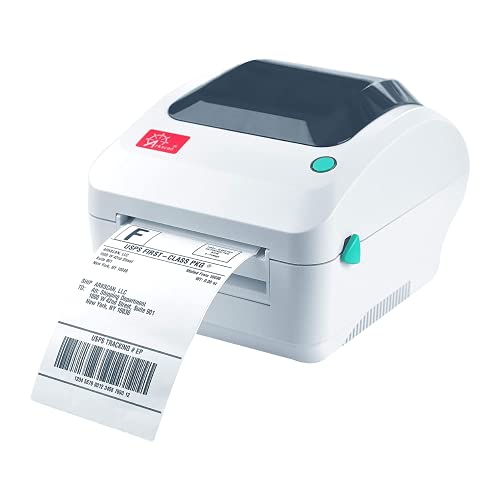
7. Arkscan 2054A Shipping Label Printer — Best for Maximum Platform Compatibility
The Arkscan 2054A takes a different approach from the other printers on this list: it's explicitly designed to work with the widest possible range of shipping platforms and label sizes rather than focusing on a premium hardware experience. The compatibility list is genuinely comprehensive — Amazon FBA, FNSKU, eBay, Etsy, PayPal, Poshmark, ShipStation, ShippingEasy, Shippo, ShipWorks, Shopify, Stamps, UPS WorldShip, USPS, FedEx Ship Manager, XPSship, PirateShip, and more. If you've ever struggled to make a printer work with a specific platform, the Arkscan's explicit multi-platform testing is reassuring.
The hardware specs are solid for the price: 5 inches per second print speed (comparable to 127mm/s, slightly below Rollo's 150mm/s but still fast), and a flexible label size range from 0.75 inches to 4.25 inches in width and 0.4 to 90 inches in length. The support for both roll paper loaded inside the printer and fanfold paper loaded from the back is a standout feature that most competitors don't offer — fanfold labels are often cheaper to buy in bulk and easier to manage in high-volume environments. The bundled BarTender UltraLite software (Windows only) adds professional label design capabilities for product labels, warehouse labels, and barcodes.
The Arkscan 2054A works on Windows, Mac, Chromebook, and Android, covering every common operating system a seller might use. Build quality is functional and durable — it's designed as a workhorse rather than a showpiece. The one area where it trails the Rollo is in the absence of a companion shipping app with rate discounts. You're buying pure printing hardware here, which means your shipping platform is entirely your choice. For a multi-channel seller juggling eBay, Amazon, Etsy, and custom orders who needs one printer that handles everything without complaint, the Arkscan 2054A delivers. It's also one of the most cost-effective options on this list for what you get.
Pros:
- Compatible with more shipping platforms than any other printer on this list
- Supports both roll and fanfold label loading — rare and practically useful
- Works on Windows, Mac, Chromebook, and Android
- Bundled BarTender UltraLite software for custom label design
Cons:
- No companion shipping app — no built-in rate discounts
- Slightly slower print speed than Rollo at 5 ips vs. 6 ips
Choosing the Right Shipping Label Printer for eBay: A Buying Guide
Not every thermal label printer is right for every seller. The differences that matter most aren't always the ones advertised on the box. Here's what to evaluate before you buy in 2026.
Connectivity: USB, Wi-Fi, or Bluetooth?
Your connectivity decision is really a decision about your workflow. USB is the simplest and most reliable option for a single-computer shipping station — there's no network to troubleshoot, no pairing to manage, and no app required. If your operation involves one person at one desk with one computer, USB delivers everything you need at the lowest cost. Wi-Fi changes the game when you have multiple devices that need to print, or when you want the freedom to print from your phone, tablet, or laptop from anywhere in the building. The Rollo Wireless is the clear winner in this category. Bluetooth sits between the two — it's wireless but short-range and typically app-dependent, making it best suited for mobile-first sellers who manage their eBay store primarily from a smartphone. The Phomemo 241BT is designed exactly for that use case.
Label Compatibility: Open vs. Proprietary Stock
This is the buying decision that has the biggest long-term cost impact, and it's the one most sellers overlook. DYMO printers — both the 5XL and 4XL — only work with DYMO-branded label stock, which is reliably available but costs more per roll than generic third-party alternatives. Every other printer on this list accepts any standard 4×6 direct thermal label, which means you can buy labels in bulk from any supplier and keep your per-label cost as low as possible. At scale — say, 50 labels per day across a full year — the difference in label costs between an open-format printer and a proprietary one can exceed the cost of the printer itself. If you're price-sensitive and expect your volume to grow, choose an open-format printer from the start.
Print Speed and Resolution
For most eBay sellers, the difference between 127mm/s and 150mm/s print speed is imperceptible in daily use — both are fast enough to keep up with any realistic shipping volume a home-based seller handles. Where speed matters is at the high end: if you're processing 200 or more shipments per day in batches, every second per label adds up. All seven printers on this list print at 203 DPI, which is the industry standard for shipping labels and produces barcodes that scan reliably across all carriers. You don't need to pay a premium for higher DPI — 203 DPI is exactly what postal and carrier scanners are calibrated for, and going higher doesn't produce any practical benefit.
Software, App Integration, and Rate Savings
A printer is only as useful as the software it works with. Rollo's Ship Manager app is a genuine differentiator — it connects directly to your eBay account and other platforms and gives you access to discounted carrier rates without a ShipStation or ShippingEasy subscription. Over time, those rate discounts can pay for the printer entirely. If you're already paying for a shipping platform subscription, this benefit is less relevant, but if you're managing shipping manually or on eBay's built-in tools, Rollo's ecosystem saves real money. DYMO's Label Software handles a wide range of label formats and integrates with Microsoft Office and QuickBooks. The MUNBYN and Arkscan are more hardware-focused — they print whatever your platform sends, reliably and without friction, but don't add a rate-discount layer on top.
FAQs
Do I need a special printer to print eBay shipping labels?
You don't strictly need a dedicated label printer — eBay labels can print on a standard inkjet or laser printer on 8.5×11 paper that you then fold and tape or cut. However, a dedicated 4×6 thermal label printer dramatically speeds up the process, eliminates ink costs, and produces labels that are more durable and scanner-friendly. For any seller moving more than a handful of packages per week, the time savings alone justify the investment.
What is the difference between a thermal label printer and a regular printer?
A thermal label printer uses heat to activate a chemical coating on specially treated label paper, producing print without any ink or toner. Regular inkjet and laser printers use liquid ink or powdered toner cartridges that need to be replaced regularly. Thermal printers have zero ongoing supply costs beyond the label rolls themselves, and the printed output is smudge-proof and moisture-resistant — both significant advantages in a shipping environment where labels get handled roughly.
Can I use any brand of labels with these printers?
It depends on the printer. DYMO's LabelWriter 5XL and 4XL models are calibrated exclusively for DYMO-branded label stock and will not work correctly with third-party labels. All other printers on this list — Rollo, MUNBYN, Phomemo, and Arkscan — accept standard 4×6 direct thermal label rolls from any manufacturer. Buying third-party labels in bulk can cut your per-label cost by 40 to 60 percent compared to DYMO-branded stock.
What size labels do I need for eBay shipping?
The standard shipping label size for eBay is 4×6 inches, which is the format used by USPS, UPS, FedEx, and all major carriers. All seven printers in this guide are designed specifically for this size. Some printers also support smaller label widths for other purposes like product labels or barcode stickers, but 4×6 is what you need for shipping packages. Make sure you order 4×6 direct thermal label rolls — not inkjet or laser label sheets.
Do these printers work directly with eBay's shipping platform?
Yes — all seven printers on this list are compatible with eBay's built-in shipping label system. When you generate a label through eBay's Seller Hub or the mobile app, you select your label printer from your system's printer list, and the label prints directly. Rollo's Ship Manager app adds an additional layer that connects directly to eBay and can pull orders automatically, which is especially useful for high-volume sellers processing batches. The other printers work just as well with eBay's native tools.
Is a wireless label printer worth the extra cost over a USB model?
It depends entirely on how you run your operation. If you ship from one dedicated desk with a single computer, a USB printer gives you everything you need at a lower price. If you print labels from multiple devices — a desktop computer, a laptop, a phone, or a tablet — or if you want the flexibility to print from anywhere in your home without being tethered to a specific machine, the wireless premium is justified. The Rollo Wireless costs more than the Rollo USB, but for a multi-device household or growing small business, the operational freedom pays for itself quickly.
Buy on Walmart
- Rollo Wireless Shipping Label Printer - Wi-Fi Thermal Label — Walmart Link
- Rollo USB Shipping Label Printer - Commercial Grade 4x6 Ther — Walmart Link
- DYMO LabelWriter 5XL Label Printer, Automatic Label Recognit — Walmart Link
- DYMO LabelWriter 4XL Thermal Label Printer (1755120) (Renewe — Walmart Link
- MUNBYN Shipping Label Printer RealWriter 941, 4x6 Thermal La — Walmart Link
- Phomemo Bluetooth Shipping Label Printer, 241BT 4X6 Wireless — Walmart Link
- Arkscan 2054A Shipping Label Printer for Windows Mac Chromeb — Walmart Link
Buy on eBay
- Rollo Wireless Shipping Label Printer - Wi-Fi Thermal Label — eBay Link
- Rollo USB Shipping Label Printer - Commercial Grade 4x6 Ther — eBay Link
- DYMO LabelWriter 5XL Label Printer, Automatic Label Recognit — eBay Link
- DYMO LabelWriter 4XL Thermal Label Printer (1755120) (Renewe — eBay Link
- MUNBYN Shipping Label Printer RealWriter 941, 4x6 Thermal La — eBay Link
- Phomemo Bluetooth Shipping Label Printer, 241BT 4X6 Wireless — eBay Link
- Arkscan 2054A Shipping Label Printer for Windows Mac Chromeb — eBay Link
The right shipping label printer doesn't just save you time — it's the foundation of a professional eBay operation that buyers trust and carriers handle without complaint.



About Remington May
Remington May is a technology writer and digital product reviewer with a focus on consumer electronics, software, and the everyday tech that shapes how people work and live. She has spent years evaluating smartphones, laptops, smart home devices, and digital tools — approaching each product from the perspective of a practical user rather than a spec-sheet enthusiast. At Pinwords, she covers tech buying guides, product reviews, smartphone and laptop comparisons, and practical how-to guides for getting more out of your devices.
Check for FREE Gifts. Or latest free books from our best messages.
Remove Ad block to reveal all the secrets. Once done, hit a button below