Best Chairs for Therapists 2026
by Remington May
After eight hours of back-to-back client sessions, a therapist's body tells the story their posture chair should have prevented. We've seen physical therapists, counselors, and behavioral specialists all searching for the same thing — a chair that supports long, mostly seated days without contributing to the very musculoskeletal issues many of them treat. Our team spent weeks evaluating ergonomic chairs specifically through the lens of therapy professionals who need comfort, adjustability, and durability for 2026.
The demands on a therapist's chair differ from a standard office setup. Many therapists lean forward during sessions, shift positions frequently, and need a chair that moves with them rather than fighting their posture. Some practitioners split time between a desk for notes and a more open seating arrangement for clients. That dual-use pattern means adjustability and ease of repositioning matter more here than in most office environments. We also considered noise — a squeaky chair during a counseling session is more than an annoyance.

Whether the priority is lumbar support for marathon documentation days or a quiet, smooth-rolling base for in-session movement, this roundup covers options across multiple price tiers. We looked at everything from premium picks like the Humanscale Freedom and Herman Miller Aeron down to budget-friendly mesh chairs and even a kneeling chair for therapists who want to break the mold entirely. For more seating deep-dives, check out our full buying guide section.
Contents
Best Choices for 2026
- #PreviewProductRating
- Bestseller No. 1
 Rating:

- Bestseller No. 2
 Rating:
 - Bestseller No. 3
 Rating:
 - Bestseller No. 4
 Rating:
 - Bestseller No. 5
 Rating:
 - Bestseller No. 6
 Rating:
 - Bestseller No. 7
 Rating:
Product Reviews
1. Humanscale Freedom Office Chair with Headrest — Best for Recline-Heavy Sessions
The Humanscale Freedom takes a radically different approach to ergonomic seating — it eliminates most manual adjustments entirely. Instead of dials and levers, the chair uses a weight-sensitive recline mechanism that automatically adapts to the sitter's movements. For therapists who shift between leaning forward to take notes and reclining during listening-intensive sessions, this self-adjusting backrest is genuinely useful. The pivoting backrest tracks spinal movement in real time, which means there's no need to stop mid-session to fiddle with tension knobs.
Build quality is excellent. The graphite frame paired with Black Fourtis fabric gives the chair a professional appearance that fits clinical or private practice settings without looking out of place. The headrest is a welcome addition for therapists who tilt back during longer conversations — it provides genuine neck support rather than just existing as an afterthought. The standard Duron arms adjust in height, which is adequate though not as versatile as 4D armrests found on some competitors.
One consideration: the carpet casters work well on standard office carpet but may be too aggressive on hardwood or tile floors common in therapy offices. Replacement casters are readily available, but it's an added cost. The chair's weight capacity and build feel robust enough for years of daily use, and the minimalist adjustment philosophy means fewer mechanical parts that could fail over time.
Pros:
- Self-adjusting recline eliminates manual tension controls
- Pivoting backrest follows natural spinal movement
- Quiet operation — no clicks or squeaks during repositioning
Cons:
- Premium price point may stretch smaller practice budgets
- Carpet-only casters require swapping for hard floors
2. Herman Miller Aeron Executive — Best for All-Day Documentation
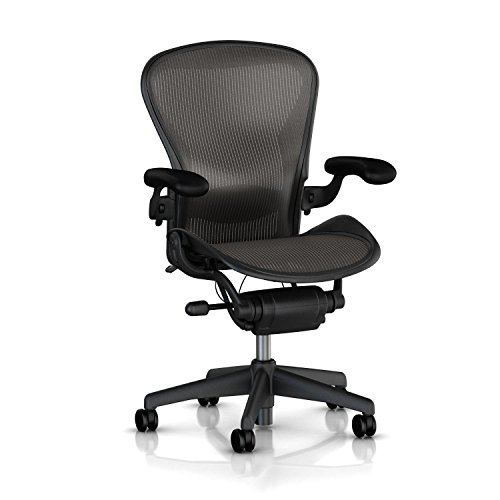
The Aeron barely needs an introduction. Herman Miller's flagship has been a staple in professional environments for decades, and the stainless steel executive edition adds a visual refinement that suits private practice settings. This Size B model fits the broadest range of body types, making it a safe choice for shared offices or practices where multiple therapists rotate through the same workspace.
What makes the Aeron stand out for therapists specifically is the combination of forward tilt and rear tilt lock. Forward tilt angles the seat pan slightly downward, which is ideal for therapists who lean toward clients during sessions or spend extended periods typing clinical notes. The lumbar support is adjustable and provides consistent pressure without creating hot spots. The mesh seat eliminates the cushion degradation problem that plagues foam-based chairs — after two or three years of daily use, most foam seats compress noticeably, but the Aeron's Pellicle mesh maintains its tension.
The 12-year warranty and 30-day money-back guarantee reduce the risk on what is admittedly a significant investment. This particular listing is open box, which brings the price down while still delivering the full Aeron experience. Fully adjustable arms allow therapists to tuck them out of the way or position them precisely for keyboard work. The chair runs warm-neutral in temperature thanks to the breathable mesh — a real advantage in smaller therapy rooms that can get stuffy.
Pros:
- Forward tilt option supports active leaning postures
- Mesh seat stays cool and doesn't degrade over time
- 12-year warranty with 30-day return window
Cons:
- Open box condition may show minor cosmetic wear
- Size B won't suit very tall or very petite therapists
3. Steelcase Amia Office Chair — Best for Extended Sitting Comfort
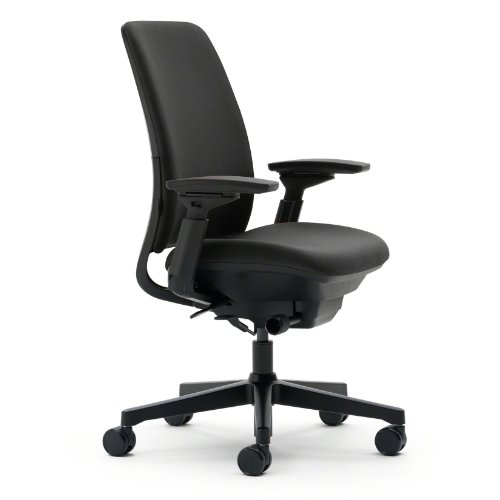
Steelcase built the Amia around one premise: sitting for eight to ten hours should not leave someone in pain. The hidden LiveLumbar system is the star feature here — it's a flexible support mechanism embedded in the backrest that responds dynamically to movement rather than sitting in a fixed position. For therapists who unconsciously shift posture dozens of times during a session, this adaptive lumbar support is more practical than a manually adjusted pad that stays put regardless of position changes.
The seat cushion deserves special mention. Steelcase used flexible edges that reduce pressure on the backs of the thighs, which matters enormously for therapists who sit for long stretches between clients. Extra cushioning throughout the seat pan means the Amia delivers a noticeably softer sit than mesh alternatives like the Aeron — this comes down to personal preference, but therapists who dislike the firmness of mesh seats will appreciate the difference. The 4D armrests adjust in height, width, pivot, and depth, allowing for precise positioning whether typing notes or sitting with hands in the lap during a session.
The full recline range locks in the upright position, which is handy for therapists who want to prevent accidental recline during client-facing work. The Buzz2 Black fabric is professional and understated. Overall, the Amia occupies a sweet spot between the premium Aeron and more budget-oriented options, delivering genuine ergonomic engineering without the flagship price tag. Therapists who also maintain a home workspace might find our guide to the best chairs for video editing useful — many of the same ergonomic principles apply to any prolonged seated task.
Pros:
- LiveLumbar adapts automatically to posture changes
- Cushioned seat with flexible edges reduces thigh pressure
- 4D armrests offer precise positioning for varied tasks
Cons:
- Fabric seat may retain more heat than mesh alternatives
- Heavier than most competitors — harder to move between rooms
4. Branch Ergonomic Chair — Best Mid-Range Value
Branch has carved out a reputation for delivering solid ergonomic performance at prices well below the legacy brands. This chair offers eight distinct adjustment points — recline angle, tilt tension, lumbar height, armrest height, armrest width, armrest depth, seat height, and seat depth. That level of customization typically lives in chairs costing twice as much. For therapists outfitting a new practice or furnishing multiple rooms, the cost savings add up quickly without sacrificing meaningful ergonomic support.
The breathable mesh backrest handles temperature regulation well, keeping things comfortable in smaller therapy rooms where air circulation can be limited. Lumbar support is adjustable in height, which is important because lumbar positioning is highly individual — a support pad that works for a 5'4" therapist will sit in the wrong spot for someone 6'1". The smooth-rolling wheels are a nice touch for therapists who move between a desk and a more open seating arrangement within the same room.
Where the Branch chair shows its price point is in the armrest padding and overall build heft. The arms feel functional but not plush, and the chair lacks the premium weight and solidity of the Steelcase or Herman Miller options. That said, for the money, it's difficult to find a more complete set of adjustments. Branch also offers a solid trial period, which takes some risk out of buying a chair without testing it in person first.
Pros:
- Eight adjustment points rival premium chairs at a fraction of the cost
- Breathable mesh back stays cool in compact rooms
- Smooth casters transition easily between surfaces
Cons:
- Armrest padding is thinner than premium alternatives
- Overall build feels lighter — less anchored during recline
5. FLEXISPOT OC3 Ergonomic Office Chair — Best Budget Mesh Option
FLEXISPOT's OC3 delivers a surprising amount of chair for its price category. The high back design with an adjustable 2D headrest provides full upper body support, which is relatively uncommon at this price point. The headrest adjusts in both height and angle, so therapists who recline during sessions can find a comfortable neck position without craning. The lockable backrest lets practitioners set a preferred recline angle and keep it there — useful for maintaining a consistent posture during client interactions.
The mesh seat and mesh back combination provides full-body airflow that keeps the chair comfortable even in warm environments. The high-density mesh resists the sagging that cheaper mesh seats develop after several months of daily use. Lumbar support is built in and adjustable, though it lacks the dynamic response of the Steelcase LiveLumbar or Humanscale's automatic system. For therapists who find their ideal lumbar position and stay there, this fixed-but-adjustable approach works fine.
Assembly is straightforward, and the chair adapts to multiple environments — home office, clinic, or shared workspace. The gray color option adds some visual variety compared to the sea of all-black office chairs. Where the OC3 falls short is in armrest adjustability (basic height only) and overall material refinement. The plastics feel budget-appropriate, and the gas lift may not be as smooth as premium alternatives. But for therapists who need a functional ergonomic chair without a four-figure investment, the OC3 earns its spot on this list. Maintaining any chair's longevity also means occasional upkeep — our guide on how to clean chair cushions covers the basics.
Pros:
- Full mesh construction provides excellent breathability
- Adjustable headrest and lockable backrest at a budget price
- Versatile enough for clinical, home, and shared office use
Cons:
- Armrests only adjust in height — no width or pivot
- Plastic components feel less refined than mid-range competitors
6. Eurotech Kinetic Series Mesh Chair — Best for Active Sitting
The Eurotech Kinetic brings a different philosophy to ergonomic seating — it's built around the idea that the best sitting posture is the next one. The chair's kinetic mechanism encourages subtle movement throughout the day, which aligns well with what many physical therapists and occupational therapists recommend to their own clients. There's an irony in therapists advising patients to move more while sitting rigidly themselves, and this chair addresses that directly.
The contemporary mesh design looks clean and professional. The backrest provides adequate support without being overly aggressive in its lumbar curve, which suits therapists who prefer a more neutral spine position. The mesh is taut enough to provide structure but gives enough to accommodate different body types. Available in two color options, it fits into most office aesthetics without standing out or looking clinical.
The Kinetic's limitations center on adjustability — it offers fewer customization options than the Branch or Steelcase chairs on this list. Therapists who need very specific armrest positions or seat depth adjustments may find the options limited. The chair works best for practitioners who value freedom of movement over locked-in precision. It's also one of the quieter chairs we evaluated, producing minimal noise during position changes — a genuine advantage during therapy sessions where mechanical sounds can be distracting.
Pros:
- Kinetic mechanism promotes healthy micro-movements
- Quiet operation suits sensitive therapy environments
- Clean, contemporary design with two color choices
Cons:
- Fewer adjustment options than similarly priced competitors
- Limited lumbar customization may not suit all body types
7. Ergonomic Kneeling Chair — Best Alternative Seating Option
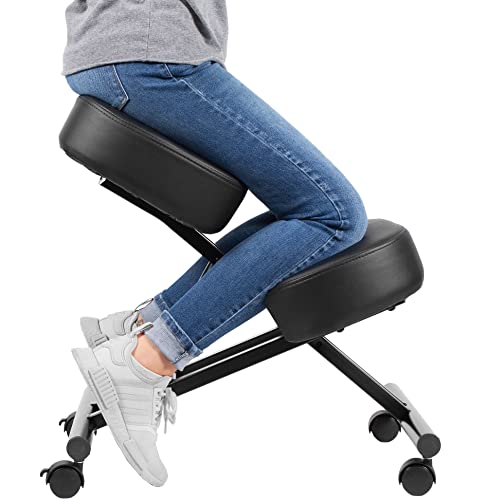
This kneeling chair represents a fundamentally different approach to seated work, and it's one that many therapists — particularly those in physical therapy and rehabilitation — already understand the science behind. The angled seat tilts the pelvis forward, naturally encouraging an upright spine without requiring conscious effort. The design distributes body weight between the buttocks and the shins, which reduces compressive force on the lumbar spine by roughly 20% compared to conventional sitting, according to research published by the National Institutes of Health.
The 3-inch vinyl cushions provide decent padding for the seat and knee pads. The strong metal base supports up to 250 pounds and feels stable during use. Brake casters are a smart inclusion — the chair stays put when weight is applied but can be rolled freely when the therapist stands up. This prevents the chair from sliding away during transitions, which is a common complaint with cheaper kneeling chairs that use standard casters.
The important caveat here is the acclimation period. Kneeling chairs engage different muscle groups than traditional seating, and most new users experience knee or shin discomfort for the first week or two. Our recommendation is to alternate between the kneeling chair and a conventional chair during the transition period. This isn't a chair for eight straight hours — it works best as a complement to a primary ergonomic chair, used for a few hours at a time. Therapists who already advocate for postural variety with their clients will appreciate the philosophy. For those who also work from a desk setup for content creation or telehealth, our review of the best chairs for writers covers additional options that prioritize prolonged desk comfort.
Pros:
- Promotes natural spinal alignment without conscious effort
- Brake casters prevent unwanted rolling during use
- Compact design fits easily in small therapy rooms
Cons:
- Requires a 1-2 week acclimation period for new users
- Not suitable for all-day use — best as a supplementary chair
Choosing the Right Chair for Therapists: A Buying Guide
Lumbar Support and Spinal Alignment
Lumbar support is the single most important factor for therapists who sit for extended periods. The lower back bears the majority of seated compressive load, and inadequate support leads to fatigue, discomfort, and eventually chronic pain. Look for chairs with adjustable lumbar height at minimum — the ideal lumbar support position varies significantly based on torso length. Dynamic lumbar systems like the Steelcase LiveLumbar or Humanscale's self-adjusting backrest go a step further by adapting to movement, which is particularly valuable for therapists who shift posture frequently during sessions.
Adjustability and Customization
A chair that cannot be configured to an individual body is just furniture. At minimum, therapists should look for adjustable seat height, seat depth, backrest angle, and armrest height. The more adjustment points available, the better the chair can be tailored to specific work patterns. Armrest adjustability matters more than many buyers realize — armrests set too high create shoulder tension, while those set too low encourage leaning. 4D armrests (height, width, pivot, depth) offer the most flexibility and are worth prioritizing for anyone who splits time between keyboard work and open-seated client sessions.
Seat Material and Temperature Management
Mesh seats and backs stay cooler than foam and fabric, which matters in smaller therapy rooms or warmer climates. However, mesh provides a firmer sit that not everyone prefers. Foam cushions offer more immediate comfort but degrade faster — most foam seats show noticeable compression after 18 to 24 months of daily use. High-density foam lasts longer but costs more. For therapists who run warm or work in spaces without robust climate control, mesh is the practical choice. For those who prioritize plush comfort, a high-quality foam seat like the Steelcase Amia's is the better fit.
Noise and Mobility
This factor is unique to therapy settings. A chair that clicks, squeaks, or groans during movement creates unwanted auditory distractions during sessions — particularly in counseling and psychotherapy environments where ambient noise levels are kept deliberately low. Test recline mechanisms and caster quality before committing. Caster type also matters: hard casters work on carpet but scratch hard floors, while soft rubber casters protect hard surfaces but may drag on thick carpet. Many therapists keep a chair mat under their desk to standardize the rolling surface and protect flooring.
Questions Answered
What type of chair is best for therapists who see clients all day?
An ergonomic task chair with adjustable lumbar support, a breathable seat, and quiet casters is the ideal combination for therapists in client-facing roles. Chairs like the Herman Miller Aeron or Steelcase Amia provide the adjustability and comfort needed for sessions lasting 45 to 60 minutes each, repeated throughout the day. The key is finding a chair that supports frequent posture changes without requiring manual readjustment between each shift.
How much should a therapist spend on an office chair in 2026?
Quality ergonomic chairs for professional use typically range from $300 to $1,500. Budget options in the $200-$400 range like the FLEXISPOT OC3 and Branch Ergonomic deliver solid daily performance. Mid-range chairs from $400-$800 add better materials and more adjustment options. Premium chairs above $800, like the Humanscale Freedom and Herman Miller Aeron, offer superior build quality, longer warranties, and features that justify the investment over a 10-plus year lifespan.
Are kneeling chairs good for therapists?
Kneeling chairs can be beneficial as a supplementary seating option, particularly for therapists who want to practice the postural variety they recommend to clients. They promote natural spinal alignment and engage core muscles. However, they are not recommended as a primary chair for all-day use — most practitioners find them comfortable for two to three hours at a time. The acclimation period of one to two weeks involves some knee and shin discomfort as the body adjusts to the new weight distribution.
What chair features help with lower back pain during long sessions?
Adjustable lumbar support is the most critical feature for managing lower back pain. Look for chairs where the lumbar pad can be moved up or down to match individual spinal curvature. A seat with adjustable depth prevents the front edge from pressing into the backs of the knees, which can contribute to poor posture. Forward tilt capability, found on chairs like the Aeron, angles the pelvis forward and reduces lumbar load during active listening or note-taking positions.
Should therapists choose mesh or cushioned chairs?
Mesh chairs provide better airflow and maintain consistent support over years of use, since mesh does not compress like foam. They tend to run firmer, which some users find less comfortable initially. Cushioned chairs offer a softer, more immediately comfortable sit but may require cushion replacement after two to three years of heavy daily use. For therapists in warm environments or those who tend to sit for very long periods, mesh is generally the more practical long-term choice.
How often should a therapist replace their office chair?
With proper maintenance, a quality ergonomic chair should last 7 to 12 years in a professional setting. Premium chairs from manufacturers like Herman Miller and Steelcase often outlast their warranties with minimal degradation. Signs that replacement is needed include visible foam compression, a loose or wobbly gas lift, backrest mechanisms that no longer hold tension, and persistent squeaking that lubrication cannot resolve. Budget chairs may need replacement every 3 to 5 years depending on daily usage hours.
Buy on Walmart
- Humanscale Freedom Office Chair with Headrest - Ergonomic Wo — Walmart Link
- Herman Miller Aeron Executive Office Chair-Stainless Steel, — Walmart Link
- Steelcase Amia Office Chair - Most Comfortable Sit - 4 Point — Walmart Link
- Branch Ergonomic Chair - A Versatile Desk Chair with Adjusta — Walmart Link
- FLEXISPOT Ergonomic Office Chair, High Back Mesh Swivel Comp — Walmart Link
- Eurotech Kinetic Series Contemporary Mesh Chair, Black — Walmart Link
- Ergonomic Kneeling Chair, Adjustable Stool for Home and Offi — Walmart Link
Buy on eBay
- Humanscale Freedom Office Chair with Headrest - Ergonomic Wo — eBay Link
- Herman Miller Aeron Executive Office Chair-Stainless Steel, — eBay Link
- Steelcase Amia Office Chair - Most Comfortable Sit - 4 Point — eBay Link
- Branch Ergonomic Chair - A Versatile Desk Chair with Adjusta — eBay Link
- FLEXISPOT Ergonomic Office Chair, High Back Mesh Swivel Comp — eBay Link
- Eurotech Kinetic Series Contemporary Mesh Chair, Black — eBay Link
- Ergonomic Kneeling Chair, Adjustable Stool for Home and Offi — eBay Link
Final Thoughts
Every therapist's body, practice style, and workspace is different, and the right chair reflects those individual needs rather than a universal ranking. We'd encourage anyone in the market to narrow the list down to two or three options based on budget and the specific features that matter most — whether that's adaptive lumbar support, breathable mesh, or the postural benefits of a kneeling chair — and take advantage of trial periods and return policies to test the chair in real working conditions before committing long-term.



About Remington May
Remington May is a technology writer and digital product reviewer with a focus on consumer electronics, software, and the everyday tech that shapes how people work and live. She has spent years evaluating smartphones, laptops, smart home devices, and digital tools — approaching each product from the perspective of a practical user rather than a spec-sheet enthusiast. At Pinwords, she covers tech buying guides, product reviews, smartphone and laptop comparisons, and practical how-to guides for getting more out of your devices.
Check for FREE Gifts. Or latest free books from our best messages.
Remove Ad block to reveal all the secrets. Once done, hit a button below