Best Duplex Scanner 2026
by Remington May
Picture this: you've got a filing cabinet stuffed with years of paper records, receipts spilling out of a shoebox, and a growing pile of contracts that should've been digitized months ago. You open a browser tab, search for "best duplex scanner," and suddenly you're staring at a wall of specs — dpi ratings, ppm figures, ADF capacities — with no idea where to start. Sound familiar? You're not alone, and the good news is that finding the right duplex scanner in 2026 doesn't have to be overwhelming.
Duplex scanners — meaning scanners that capture both sides of a page in a single pass — have become a staple for home offices, small businesses, and enterprise teams alike. Whether you're scanning contracts, digitizing receipts, or building a paperless archive, the right machine can cut your workload in half. The market has matured considerably, and you now have excellent options across every price point, from compact USB-powered units to network-ready workhorses built for daily high-volume loads. If you're also looking to round out your office setup, our guide to the best small compact desktop printers is a natural companion read.
In this guide, we've tested and researched seven of the top duplex scanners available right now. We cover speed, image quality, software, connectivity, and real-world usability — everything you need to make a confident decision. According to Wikipedia's overview of image scanners, modern ADF-based units have largely replaced flatbed-only models for document work, and that shift is clearly reflected in what the market offers today. Let's dig in.
Contents
- Best Choices for 2026
- In-Depth Reviews
- Fujitsu ScanSnap iX1600 — Best for Teams
- ScanSnap iX2400 — Best for Speed & Simplicity
- Fujitsu fi-8150 — Best for Heavy-Duty Use
- Epson DS-530 II — Best Mid-Range Pick
- Epson WorkForce ES-400 II — Best for Home Office
- Epson WorkForce ES-500W II — Best Wireless
- HP ScanJet Pro 3600 f1 — Best Flatbed/ADF Combo
- Key Features to Consider When Choosing
- Common Questions
- Final Thoughts
Best Choices for 2026
- #PreviewProductRating
- Bestseller No. 1
 Rating:

- Bestseller No. 2
 Rating:
 - Bestseller No. 3
 Rating:
 - Bestseller No. 4
 Rating:
 - Bestseller No. 5
 Rating:
 - Bestseller No. 6
 Rating:
 - Bestseller No. 7
 Rating:
In-Depth Reviews

1. Fujitsu ScanSnap iX1600 ADF Scanner — Best for Teams & Shared Workspaces
The Fujitsu ScanSnap iX1600 is one of the most polished duplex scanners you'll find at this price tier, and it earns that reputation through a combination of thoughtful design and genuinely useful software. The large, responsive 4.3-inch touchscreen is the centerpiece — you can configure up to 30 customized scan profiles directly on the device, which makes it ideal when multiple people need quick access to different workflows. Whether you're scanning to a shared cloud folder, a local network drive, or directly to email, the iX1600 handles it without forcing you to touch a computer. Up to 40 pages per minute with automatic duplex scanning keeps productivity high, and the 50-sheet ADF means you can walk away while a batch runs.
Build quality is solid. The white finish looks clean on a shared desk, and the paper feed mechanism feels reliable rather than delicate. Fujitsu bundles ScanSnap Home, a software suite that automatically classifies documents, business cards, receipts, and photos — so your scans don't just land in a folder, they get organized. The iX1600 also supports Wi-Fi, so team members can scan from the device without anyone needing to physically plug in a cable. That said, the ADF capacity at 50 sheets is good but not class-leading, and if your workload regularly involves very long document batches, you may find yourself reloading more often than you'd like.
For small offices or families digitizing household documents, the iX1600 strikes an excellent balance between accessibility and power. It's genuinely designed so that someone who has never touched a scanner can figure it out in under two minutes. If you're building out a full office setup, our roundup of the best 11×17 printers for architects covers large-format output that pairs well with a quality document scanner like this one.
Pros:
- Large touchscreen with up to 30 customizable scan profiles
- Fast 40 ppm duplex scanning with Wi-Fi connectivity
- Excellent ScanSnap Home software with auto document classification
- Intuitive enough for non-technical users
Cons:
- 50-sheet ADF may feel limiting for very high-volume batches
- Premium price compared to entry-level alternatives
2. ScanSnap iX2400 High-Speed Scanner — Best for Speed & One-Touch Simplicity
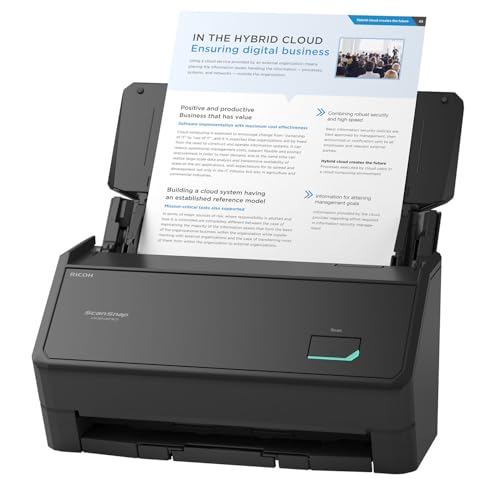
If you want speed and don't need a touchscreen or Wi-Fi, the ScanSnap iX2400 makes a compelling argument for itself. Up to 45 pages per minute puts it ahead of most competitors at a similar price, and the 100-sheet ADF capacity means you can load a genuinely large batch and walk away. The one-touch Quick Menu is the defining feature here — press the button, and the scanner figures out what you're scanning, cleans up the image, and routes it where it needs to go. It's fast, predictable, and surprisingly smart about image correction.
The iX2400 connects via USB, which some people will see as a limitation and others will see as a reliability advantage. There's no wireless to configure, no network dependency, and no dropped connection mid-batch. The wired USB 3.2 connection delivers consistent throughput, and the scanner handles a wide variety of media — business cards, receipts, standard documents, photos, and even envelopes all feed cleanly through the ADF. The 100-sheet capacity is a genuine upgrade over the iX1600 if your typical workflow involves processing large stacks at once.
The trade-off is that the iX2400 is fundamentally a single-user, single-desk device. There's no network sharing, no touchscreen for per-user profiles, and no wireless for anyone who needs to scan without being physically tethered to the machine. If you're one person with a heavy scanning load and you just want raw throughput without fuss, it's hard to argue with what the iX2400 offers. The Quick Menu is genuinely one of the slickest UX implementations in this category — scan-drag-drop to your favorite apps takes seconds, not minutes.
Pros:
- Blazing 45 ppm scan speed with 100-sheet ADF capacity
- One-touch Quick Menu simplifies the entire workflow
- Reliable wired USB connection — no network dependencies
- Handles diverse media types including receipts and business cards
Cons:
- No Wi-Fi — not suitable for shared or networked office environments
- No touchscreen for multi-profile configuration
3. Fujitsu fi-8150 Document Scanner — Best for Heavy-Duty Professional Use
The Fujitsu fi-8150 is a different beast from the ScanSnap line — this is a professional-grade workgroup scanner designed for environments where reliability and network connectivity are non-negotiable. 50 pages per minute with 100-image-per-minute duplex output at up to 600 dpi optical resolution puts it at the top of the speed charts in this roundup. The 100-sheet ADF handles high-volume batches without complaint, and the advanced paper feeding system deals confidently with mixed media including passports, booklets, and business cards alongside standard A4 documents.
The fi-8150 offers both USB 3.2 and wired LAN connectivity, which is a significant differentiator if you need to share the scanner across multiple workstations without routing everything through a single computer. You can configure it on your local network and let multiple users send jobs directly. There's also a manual feed mode accessible via the operator panel for odd-shaped or fragile documents that shouldn't go through the ADF. The build quality reflects its professional positioning — this scanner is built to sustain daily high-volume use, not just occasional batches.
The software ecosystem around the fi series is more enterprise-oriented than ScanSnap. You get PaperStream Capture for document capture workflows, plus compatibility with a wide range of third-party document management systems. This makes the fi-8150 a better fit for businesses that have existing document management infrastructure. The price is higher, and the setup process demands more technical comfort than the plug-and-play ScanSnap units. But if you're running a law office, medical practice, or any business with serious daily scanning volume, the fi-8150's combination of speed, network connectivity, and build durability makes it worth every dollar.
Pros:
- 50 ppm / 100 ipm duplex speed — fastest in this roundup
- Dual connectivity: USB 3.2 and wired LAN for network sharing
- Handles diverse media including passports, booklets, and business cards
- Built for sustained high-volume daily use
Cons:
- Higher price point than consumer-grade alternatives
- Setup and software more complex — better suited to IT-supported environments
4. Epson DS-530 II Color Duplex Document Scanner — Best Mid-Range Pick
Epson's DS-530 II lands in a sweet spot for users who need reliable duplex scanning performance without paying for enterprise-level features they'll never use. At 35 pages per minute with one-pass duplex scanning, it handles everyday office workloads comfortably — contracts, invoices, correspondence, and multi-page reports all process efficiently. The 50-page ADF is standard for this class, and the overall build has a solid, purposeful quality that feels designed to sit on a desk and actually get used rather than gather dust.
One feature that stands out on the DS-530 II is its Slow Speed Mode, which lets you drop the feed rate when processing delicate or irregularly shaped documents. It's a practical addition that prevents paper jams and protects documents you can't afford to damage. Epson also quotes a peak daily duty cycle of up to 4,000 sheets, which gives you a realistic ceiling for sustained daily use — well above what most small offices will ever push through. The programmable job buttons add workflow flexibility without requiring you to open software every time.
The DS-530 II connects via USB only — no Wi-Fi, no Ethernet — which keeps it in single-user territory. Epson's bundled scanning software is competent if not spectacular, and TWAIN driver compatibility ensures it works with whatever document management system your office already uses. If you're looking for a dependable, no-frills duplex scanner that punches above its price in build quality and duty cycle, the DS-530 II is a strong mid-range contender. Check our buying guide section for a broader look at what to prioritize when shopping this category.
Pros:
- 35 ppm one-pass duplex at a competitive mid-range price
- Slow Speed Mode protects delicate documents
- High 4,000-sheet peak daily duty cycle
- Programmable job buttons for workflow customization
Cons:
- USB only — no wireless or network connectivity
- 50-sheet ADF is adequate but not exceptional
5. Epson WorkForce ES-400 II Color Duplex Desktop Scanner — Best for Home Office
The Epson WorkForce ES-400 II is aimed squarely at home office users and remote workers who need real scanning capability without occupying half their desk. It's compact, it's fast enough for everyday use, and it pairs with software that actually makes sense for how individuals work rather than how IT departments think people work. The 50-sheet ADF with high-speed duplex output handles stacks of mail, tax documents, receipts, and general correspondence without breaking a sweat. For the volume a single person typically generates, this scanner is more than adequate.
Epson ScanSmart is the bundled software, and it's genuinely user-friendly. Automatic file naming based on document content, direct email integration, and one-click cloud upload cover the most common home office scanning scenarios. You can preview scans before saving, crop and rotate automatically, and convert to searchable PDFs with OCR — all without needing to install a separate application. The TWAIN driver is included for users who prefer working within their own document management setup.
The ES-400 II delivers solid image adjustment tools including automatic deskew, blank page removal, and color dropout — features that might sound minor but genuinely improve scan quality in real-world mixed-document batches. It's a USB-connected scanner, which is perfectly fine for a single desk setup. If you're working from home and you've been putting off digitizing your paper trail, this is one of the more painless ways to get started. It won't overwhelm you with options, but it won't leave you wanting for core functionality either.
Pros:
- Compact footprint — fits comfortably on a home office desk
- ScanSmart software is intuitive with automatic file naming and cloud integration
- Automatic image correction tools improve scan quality
- Solid value for individual or home office use
Cons:
- USB only — not shareable across multiple workstations
- Not designed for high daily volume workloads
6. Epson WorkForce ES-500W II Wireless Color Duplex Scanner — Best Wireless Option
The Epson WorkForce ES-500W II steps up from the ES-400 II with one critical addition: wireless connectivity. If you've ever had to rearrange a desk just to plug in a scanner cable, you'll immediately understand why this matters. You can place the ES-500W II anywhere within Wi-Fi range and scan to your computer, a smartphone, a tablet, or directly to cloud storage — all without a cable in sight. Single-Step Technology captures both sides in one pass at up to 35 ppm, keeping throughput comparable to its wired sibling while adding the flexibility of a cable-free setup.
The Epson Smart Panel mobile app is the key to making wireless scanning actually convenient. You can initiate scans from your phone, preview results, and route files to Dropbox, Google Drive, or other cloud destinations without ever sitting at a computer. For people who split time between a desk and other areas of a home or small office, that kind of flexibility is genuinely useful rather than just a marketing feature. The 50-sheet ADF handles standard batches cleanly, and the same ScanSmart software available on the ES-400 II carries over here.
It's worth noting that the ES-500W II costs somewhat more than the ES-400 II, and the core scanning performance is essentially identical — the premium is entirely for the wireless capability. If you never need to scan from anywhere other than directly in front of your desk, you can save some money with the wired model. But if wireless matters to you, the ES-500W II executes it reliably. The Epson Smart Panel app is more polished than many OEM mobile scanning apps, which tends to be a weak point for scanner manufacturers in general.
Pros:
- Wi-Fi connectivity — scan from anywhere in range without cables
- Epson Smart Panel mobile app enables smartphone and tablet scanning
- 35 ppm duplex with Single-Step Technology
- Direct cloud storage integration (Dropbox, Google Drive, etc.)
Cons:
- Price premium over the ES-400 II for wireless alone
- 50-sheet ADF limits batch size for higher-volume needs
7. HP ScanJet Pro 3600 f1 Flatbed/ADF Scanner — Best Flatbed & ADF Combination
The HP ScanJet Pro 3600 f1 is the only model in this roundup that combines a full flatbed glass with an ADF, which makes it a different tool from the rest of the field. If you regularly scan bound documents, thick items, or anything that can't safely feed through an ADF, the flatbed is invaluable. For everything else — stacks of standard documents — the 60-page, two-sided, single-pass ADF handles duplex scanning at up to 30 ppm/60 ipm. That's the slowest speed in this comparison, but it's still fast enough for typical office workloads, and the flatbed flexibility compensates meaningfully.
Output format support is a practical strength of the ScanJet Pro 3600. You can scan directly to text, image, PDF, Word documents (DOC/DOCX), Excel spreadsheets (XLS/XLSX), and CSV — without needing a separate OCR application. That's a broader native output range than most scanners in this category offer, and for users who need to extract data from scanned documents into editable formats, it saves a significant amount of post-processing time. The 600 dpi optical resolution delivers clean, sharp results across all document types.
HP rates the ScanJet Pro 3600 for up to 3,000 pages per day, which places it comfortably in the mid-to-heavy office use range. It connects via USB, and HP's software ecosystem is reasonably well-integrated with Windows environments. The flatbed adds physical size to the unit — it's a larger footprint than ADF-only scanners — so desk space is a consideration. But if you need both flatbed and ADF capability in a single device and you want native conversion to Word and Excel, this is genuinely the right tool. For readers interested in how output format quality compares across different document devices, our guide to the best printers for stickers touches on similar image fidelity questions in a different context.
Pros:
- Combines flatbed glass and 60-page single-pass duplex ADF
- Native output to Word, Excel, PDF, and CSV without extra software
- 600 dpi optical resolution for sharp, detailed scans
- 3,000-page daily duty cycle supports sustained office use
Cons:
- Slower ADF at 30 ppm compared to Fujitsu and ScanSnap competitors
- Larger physical footprint due to flatbed glass
Key Features to Consider When Choosing a Duplex Scanner
Scan Speed and ADF Capacity
Pages per minute (ppm) for single-sided and images per minute (ipm) for duplex are the primary speed metrics to evaluate. In practical terms, a 35 ppm scanner finishes a 50-page double-sided stack in roughly three minutes. If you're scanning occasionally — a few batches per week — almost any scanner in this guide will feel fast enough. But if you're processing hundreds of pages daily, the difference between 30 ppm and 50 ppm becomes a real productivity factor. ADF capacity matters in parallel: a 50-sheet feeder works for most users, but if your typical batch exceeds that, you'll be reloading constantly. The iX2400's 100-sheet ADF is a meaningful advantage for heavy batchers.
Connectivity: USB, Wi-Fi, or Wired LAN
Your connectivity choice determines how the scanner fits into your workflow. USB-only scanners are simpler and more reliable — no network configuration, no wireless dropout, just a cable and consistent performance. They work perfectly for single-user setups. Wi-Fi adds the convenience of scanning from anywhere in range and enables mobile app integration, which the Epson ES-500W II leverages well. Wired LAN (Ethernet) is the enterprise choice — it allows multiple users across a network to share one scanner without routing through a single host computer, which is exactly what the Fujitsu fi-8150 provides. Match the connectivity type to how many people will use the scanner and where it will live.
Software and Output Format Support
Hardware specs get most of the attention, but software is where the day-to-day experience actually happens. Look for scanners with bundled software that handles your most common output needs without requiring third-party applications. Searchable PDF creation (which requires OCR) is a baseline expectation. Direct conversion to Word or Excel — as the HP ScanJet Pro 3600 offers natively — saves significant time if you need editable output. Cloud integration (Dropbox, Google Drive, OneDrive) is increasingly standard and worth confirming before you buy. If your office already uses a document management system, verify TWAIN driver compatibility, which is broadly supported across all scanners in this guide.
Flatbed vs. ADF-Only Design
ADF-only scanners are faster, more compact, and better suited to high-volume document workflows. Flatbed scanners add the ability to scan bound books, fragile documents, passports, and oversized items that can't feed through an ADF safely. The HP ScanJet Pro 3600 f1 is the only model here that offers both. If your scanning is 95% standard documents, an ADF-only unit is the smarter choice — you get more speed in less desk space. But if even a small portion of your work involves items that can't be fed automatically, having that flatbed glass available can prevent real damage to irreplaceable documents. Think honestly about what you'll actually be scanning before you decide.
Common Questions
What does duplex scanning actually mean?
Duplex scanning means the scanner captures both sides of a page automatically — front and back — in a single pass through the document feeder. You don't need to flip the stack and run it through twice. All seven scanners in this guide support duplex scanning, which roughly doubles throughput compared to simplex-only machines when working with two-sided documents.
How fast a scanner do I actually need?
For home office or occasional use, 25–35 ppm is entirely sufficient. You'd have to scan a lot of pages before you noticed the difference between 35 and 50 ppm in practice. If you're processing several hundred to thousands of pages daily in a business environment, prioritizing speed makes more sense. Most users overestimate how much raw speed they need and underestimate how much they value ADF capacity, software quality, and connectivity flexibility.
Can I share a duplex scanner across multiple computers?
It depends on the scanner. USB-only models like the ScanSnap iX2400 and Epson DS-530 II are effectively single-user devices — whichever computer they're plugged into owns them. Wi-Fi models like the Epson ES-500W II can serve multiple users wirelessly but still process one job at a time. The Fujitsu fi-8150 with its wired LAN port is the cleanest solution for true multi-user shared scanner environments.
What resolution do I need for document scanning?
For standard documents — text, contracts, forms — 300 dpi produces clean, searchable results at manageable file sizes. Use 600 dpi when you need to capture fine detail, such as photos, small print, or documents you'll need to enlarge. Higher resolution means larger file sizes and slower scan speeds, so 300 dpi is the practical default for most business document workflows. All scanners in this guide offer at least 600 dpi optical resolution, giving you full headroom.
Is optical character recognition (OCR) built into these scanners?
OCR is typically handled by bundled software rather than the scanner hardware itself. Fujitsu's ScanSnap Home and Epson's ScanSmart both include OCR that converts scanned pages into searchable PDFs or editable text. The HP ScanJet Pro 3600 goes further with native export directly to Word and Excel formats. If searchable PDF output is important to your workflow, confirm the bundled software supports it before purchasing — it's standard across this guide's selections, but capability levels vary.
How do I know if a duplex scanner will work with my document management software?
The most reliable compatibility indicator is TWAIN driver support, which is an industry-standard interface that most document management applications use to communicate with scanners. All scanners in this guide include TWAIN drivers. If you use a specific enterprise document management system, check the manufacturer's compatibility list. For common platforms like SharePoint, Dropbox, Google Drive, and most DMS solutions, you'll have no issues with any of the scanners covered here.
Buy on Walmart
- Fujitsu ScanSnap iX1600 ADF Scanner - 600 dpi Optical, White — Walmart Link
- ScanSnap iX2400 High-Speed Simple One-Touch Button Color Doc — Walmart Link
- Fujitsu fi-8150 Document Scanner, ADF A4 Duplex USB 3.2 Netw — Walmart Link
- Epson DS-530 II Color Duplex Document Scanner for PC and Mac — Walmart Link
- Epson Workforce ES-400 II Color Duplex Desktop Document Scan — Walmart Link
- Epson Workforce ES-500W II Wireless Color Duplex Desktop Doc — Walmart Link
- HP ScanJet Pro 3600 f1 Flatbed/ADF Scanner - 600 dpi Optical — Walmart Link
Buy on eBay
- Fujitsu ScanSnap iX1600 ADF Scanner - 600 dpi Optical, White — eBay Link
- ScanSnap iX2400 High-Speed Simple One-Touch Button Color Doc — eBay Link
- Fujitsu fi-8150 Document Scanner, ADF A4 Duplex USB 3.2 Netw — eBay Link
- Epson DS-530 II Color Duplex Document Scanner for PC and Mac — eBay Link
- Epson Workforce ES-400 II Color Duplex Desktop Document Scan — eBay Link
- Epson Workforce ES-500W II Wireless Color Duplex Desktop Doc — eBay Link
- HP ScanJet Pro 3600 f1 Flatbed/ADF Scanner - 600 dpi Optical — eBay Link
Final Thoughts
There's a genuinely good duplex scanner for every need in this 2026 lineup — whether you're a solo remote worker digitizing a backlog, a small team sharing a networked device, or a business running hundreds of pages through the feeder every day. Take stock of your actual volume, connectivity requirements, and software needs, then match them to the right machine from this list. The right scanner doesn't just digitize your documents — it removes paper from your workflow for good.



About Remington May
Remington May is a technology writer and digital product reviewer with a focus on consumer electronics, software, and the everyday tech that shapes how people work and live. She has spent years evaluating smartphones, laptops, smart home devices, and digital tools — approaching each product from the perspective of a practical user rather than a spec-sheet enthusiast. At Pinwords, she covers tech buying guides, product reviews, smartphone and laptop comparisons, and practical how-to guides for getting more out of your devices.
Check for FREE Gifts. Or latest free books from our best messages.
Remove Ad block to reveal all the secrets. Once done, hit a button below