Best Book Scanner 2026
by Remington May
You've got a shelf full of old textbooks, a stack of family recipe notebooks, and maybe a library of vintage magazines you'd hate to lose. You go looking for the best book scanner and immediately hit a wall — overhead scanners, flatbeds, overhead cameras, OCR software bundles. The options are genuinely confusing. We've done the homework so you don't have to.
Book scanners in 2026 fall into two camps: overhead (contactless) scanners that hover above your book without bending the spine, and flatbed scanners that press pages flat against glass. Each type suits a different use case, and picking the wrong one is an expensive mistake. This guide covers seven of the best options at every budget and use case, from professional-grade archiving tools to slim desktop flatbeds for the occasional scan.
Whether you're a librarian digitizing rare manuscripts, a student scanning course readings, or just someone who wants to preserve grandma's cookbooks, there's a scanner on this list built for your situation. Check out our full buying guide for scanners across all categories, and if you also need something compact for travel, our roundup of the best portable scanners for Mac is worth a look. Let's get into it.

Contents
- Standout Models in 2026
- Full Product Breakdowns
- ScanSnap SV600 — Best Overhead Scanner
- CZUR ET24 Pro — Best 24MP Professional
- CZUR Shine Ultra — Best Portable Option
- Plustek OpticBook 4900 — Best Flatbed for Books
- CZUR M3000 Pro V3 — Best High-Resolution Pro
- Epson Perfection V39 II — Best Budget Flatbed
- Canon CanoScan Lide 400 — Best Slim Flatbed
- Key Features to Consider When Choosing
- Common Questions
Standout Models in 2026
- #PreviewProductRating
- Bestseller No. 1
 Rating:

- Bestseller No. 2
 Rating:
 - Bestseller No. 3
 Rating:
 - Bestseller No. 4
 Rating:
 - Bestseller No. 5
 Rating:
 - Bestseller No. 6
 Rating:
 - Bestseller No. 7
 Rating:
Full Product Breakdowns
1. ScanSnap SV600 Overhead Book and Document Scanner — Best Overhead Scanner Overall
The Fujitsu ScanSnap SV600 is the gold standard for contactless book scanning. It hovers above your document on a curved arm — you place the open book underneath, press scan, and it captures the full spread in under three seconds. No pressing, no bending, no spine damage. That matters a lot when you're scanning rare books, fragile magazines, or anything you can't afford to flatten under glass.
The SV600's Auto Book Correction is its killer feature. The camera detects the curve of an open book's pages and mathematically flattens them into straight, readable text. It's not perfect on extremely thick or rigid volumes, but for standard books and magazines it works remarkably well. The Multi Document Detection function lets you throw several business cards or clippings on the surface at once — it crops and rotates each one automatically.
At a higher price point than most flatbeds, the SV600 justifies itself if you scan books regularly. If you only scan loose paper, this is overkill. But for book digitization specifically, it's the most elegant solution on this list.
Pros:
- Contactless scanning — zero spine stress or page damage
- Auto Book Correction flattens page curves automatically
- Scans multiple documents in one pass with auto-crop and rotate
- Fast capture speed — under 3 seconds per scan
- Works with newspapers, magazines, thick reference books
Cons:
- Premium price — higher than most flatbed alternatives
- Curve correction struggles on very thick or rigid bindings
- Requires a dedicated flat surface area for the arm
2. CZUR ET24 Pro Professional Book Scanner — Best 24MP All-Rounder
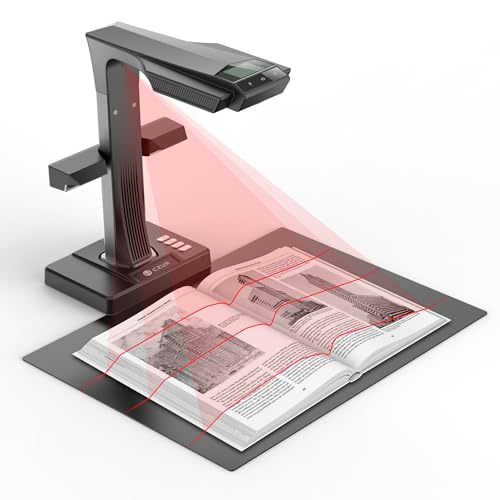
The CZUR ET24 Pro is an overhead camera scanner built around a 24MP sensor at 5696×4272 resolution — that's sharper than most competitors at this price. CZUR's third-generation auto-flatten and deskew technology handles the curve correction, producing clean, readable scans from open books without you pressing anything down. It supports A3-sized documents, making it suitable for large-format books, architectural drawings, and spreadsheets.
One major advantage here is platform flexibility. Unlike many competitors that only support Windows, the ET24 Pro runs on macOS 10.13 or later, Windows XP through 11, and multiple Linux distributions including Ubuntu 20.04, Ubuntu 22.04, and Linux Mint. If you're on Linux and need a capable book scanner, your options are extremely limited — this is one of the few that actually works. The built-in OCR (optical character recognition — technology that converts scanned images into editable text) covers 180+ languages.
One note: CZUR explicitly warns that very glossy or reflective paper doesn't scan well due to glare. That's a real limitation if you're scanning heavily coated magazine pages or photo books. For standard book paper and documents, though, the ET24 Pro delivers professional results.
Pros:
- 24MP camera — class-leading image resolution
- Third-generation flatten and deskew technology
- Supports Windows, macOS, and multiple Linux distros
- A3 capture area handles oversized books and documents
- 180+ language OCR built in
- HDMI output for live display or teaching use
Cons:
- Glare on very shiny paper degrades scan quality
- Software interface has a learning curve
- Larger footprint than portable alternatives
3. CZUR Shine Ultra Smart Portable Document Scanner — Best Portable Book Scanner
If you want overhead book scanning without the bulk, the CZUR Shine Ultra is the most portable option in this category. It folds down for easy transport and captures A3-sized documents at roughly one second per page — fast enough to get through a textbook chapter without losing your mind. The patented page-flattening technology corrects curve distortion, though CZUR notes this works best on thinner books. For thick hardcovers, you're better served by the ET series.
The Shine Ultra doubles as a document camera for live video — it's compatible with Zoom, Google Meet, and Skype, making it a dual-purpose tool for remote teachers or presenters who also need to scan. The OCR engine handles 180+ languages and outputs to JPG, PDF, searchable PDF, Word, and Excel. Note that TIFF output requires converting from the scanned JPG — it's a minor workflow wrinkle but worth knowing upfront.
The Shine Ultra does not support Android or iOS — Windows and macOS only. If you're primarily working from a tablet or mobile device, this won't work for you. For desktop and laptop users who need a flexible, space-saving scanner, it's a strong pick. Worth comparing with our list of the best large format scanners if your documents regularly exceed A3 size.
Pros:
- Portable and foldable — easy to move between locations
- ~1 second per page scan speed
- A3 capture area covers most books and documents
- Works as a live document camera for Zoom/Meet/Skype
- 180+ language OCR with multiple output formats
Cons:
- Page flattening less effective on thick hardcover books
- No Android or iOS support
- TIFF export requires extra conversion step
4. Plustek OpticBook 4900 Scanner with BookMaker — Best Flatbed for Book Organization
The Plustek OpticBook 4900 takes a different approach from the overhead scanners. It's a flatbed, but it's engineered specifically for books — the scanning element sits just 1mm from the book's edge, which dramatically reduces the shadow and distortion you normally get near the spine. Most flatbed scanners create a dark, blurry gutter at the center of every two-page spread. The OpticBook 4900 minimizes that problem significantly.
The bundled BookMaker software is the real differentiator here. It's a full document management system: you scan your pages, organize them into chapters, add tags and notes, run full-text OCR, and search across your entire scanned library by word, phrase, page content, or note. For researchers, students, or anyone building a searchable personal library, that's genuinely useful. The workflow is straightforward — create folder, scan, edit and export.
You will need to press pages flat yourself, and very curved or stiff books are harder to work with than overhead alternatives. But if you're digitizing a large number of standard paperbacks and want an organized, searchable archive at the end of it, the OpticBook 4900 is a thoughtful and well-executed tool.
Pros:
- Edge-to-edge scanning minimizes spine shadow on flatbed
- BookMaker software provides full document management and search
- AI text recognition with high accuracy OCR
- Page tagging and note-taking built into the software
- Simple three-step workflow: create, scan, export
Cons:
- Still a flatbed — requires pressing pages flat manually
- Struggles with thick, stiff, or very curved bindings
- Slower per-page workflow than overhead camera scanners
5. CZUR M3000 Pro V3 Professional Book Scanner — Best High-Resolution Professional
The CZUR M3000 Pro V3 is the heavy-duty professional option in the CZUR lineup. The headline spec is a 48MP CMOS sensor — double the resolution of the ET24 Pro — making it the choice for archivists, libraries, and professionals who need maximum detail from every scan. The dual LED illumination system provides even, consistent lighting across the scan surface, reducing hotspots and shadows that can obscure fine text or illustrations.
Instant Page Separation is the standout feature. When you open a book and scan a two-page spread, the software automatically detects the spine and splits the image into two separate page files. That saves you significant post-processing time when you're scanning hundreds of pages. The result is a clean, organized file set where each page is its own properly named document.
This is a professional-tier tool at a professional price. If you're scanning occasionally for personal use, the ET24 Pro or Shine Ultra will serve you better without the cost premium. But for institutional or high-volume use where image quality is non-negotiable, the M3000 Pro V3 is worth the investment. If you're also interested in digitizing physical film, take a look at our guide to the best negative scanners for a complementary setup.
Pros:
- 48MP CMOS sensor — highest resolution on this list
- Instant Page Separation splits two-page spreads automatically
- Dual LED illumination for even, shadow-free lighting
- Built for high-volume professional and institutional use
- Superior detail capture for fine text, illustrations, and maps
Cons:
- Significant price premium over consumer-grade models
- Larger and heavier than portable or mid-range alternatives
- Overkill for casual personal scanning needs
6. Epson Perfection V39 II Color Photo & Document Flatbed Scanner — Best Budget Flatbed
The Epson Perfection V39 II is the entry-level pick for people who need a reliable flatbed scanner without spending much. At 4800 dpi (dots per inch) optical resolution, it captures photos, documents, books, and artwork with excellent clarity — more than enough for standard digitization tasks. It's compact and lightweight, USB-powered, so there's no separate power adapter to deal with.
The V39 II includes Epson ScanSmart software, which handles cloud storage, automatic image stitching for oversized items, and basic document organization. The high-rise, removable lid accommodates thicker items including books — you can remove the lid entirely to lay a large or thick book flat on the glass. It won't eliminate spine distortion the way a dedicated book scanner does, but for thin paperbacks and standard documents it performs well.
Be realistic about what a budget flatbed can do for books. Thick hardcovers will produce gutter shadow and curve distortion that you'll need to correct manually in software. For scanning photos, flat documents, and the occasional thin paperback, the V39 II delivers solid value. If you need more sheet-fed or duplex capability, our guide to the best duplex scanners covers faster options for high-volume document work.
Pros:
- 4800 dpi optical resolution — sharp, detailed scans
- Compact and USB-powered — no extra power brick
- Removable lid accommodates thick books
- Epson ScanSmart includes cloud and stitching features
- Strong value at budget price
Cons:
- Flatbed design means spine shadow on thick books
- No automatic curve correction or page separation
- Slower scan speeds than overhead camera models
7. Canon CanoScan Lide 400 Slim Scanner — Best Ultra-Slim Flatbed
The Canon CanoScan Lide 400 is the slimmest, most desk-friendly flatbed on this list at just 0.4 inches thick. A single USB-C cable handles both data and power — no wall adapter, no driver disc required. Scan speeds hit as fast as 8 seconds per page, and the 4800 x 4800 dpi resolution captures fine detail for photos, documents, and artwork. Built-in color restoration and dust removal help rescue older or faded materials.
The EZ Buttons make it genuinely easy to use. Auto Scan mode detects what you're scanning and adjusts settings accordingly. Dedicated PDF buttons let you scan multi-page PDFs directly — searchable and editable — without touching software menus. For the occasional book scanner who mostly scans documents and photos, this workflow is fast and frictionless.
Like the Epson V39 II, the Lide 400 is a flatbed without book-specific features. You won't get automatic curve correction or spine shadow elimination. But it's thinner than most smartphones, takes up almost no desk space, and produces excellent scans for flat or moderately thick materials. If you want something that lives in a drawer and comes out when needed, this is your pick for 2026.
Pros:
- Ultra-slim 0.4-inch profile — fits anywhere
- Single USB-C cable for power and data
- 8-second scan speed — fast for a flatbed
- 4800 x 4800 dpi — high-quality image capture
- EZ Buttons with auto-detect scanning mode
- Built-in color restore and dust removal
Cons:
- No book-specific features — spine shadow on thick volumes
- Lid doesn't remove for very thick books
- Not suited for high-volume professional book digitization
Key Features to Consider When Choosing a Book Scanner
Overhead vs. Flatbed: The Most Important Decision
This is the single biggest choice you'll make. Here's how to think about it:
- Overhead (contactless) scanners like the ScanSnap SV600 and CZUR models never touch your book. They photograph from above. This protects fragile spines, eliminates the need to press pages flat, and handles thick volumes that won't lie flat at all. They're faster for books specifically.
- Flatbed scanners press pages against glass. They're more affordable, produce excellent results for flat documents and photos, and are fine for thin paperbacks. They struggle with thick or rigid books, creating gutter shadows and curved text near the spine.
- If books are your primary target, go overhead. If you mostly scan flat documents and occasionally scan a book, a quality flatbed works fine.
Resolution: How Much Do You Actually Need?
Resolution is measured in dpi (dots per inch) — higher means more detail per scan.
- 300 dpi — minimum for readable text documents. Good for personal archives you'll read on screen.
- 600 dpi — better for photos and fine illustrations. Recommended for most book scanning.
- 1200 dpi and above — for archival quality, extremely fine print, or images you plan to print large. The CZUR M3000 Pro V3's 48MP sensor captures at this level.
- For standard textbooks and novels, 300–600 dpi is more than enough. Don't pay for resolution you won't use.
OCR Software: Turning Scans into Searchable Text
OCR (optical character recognition) converts your scanned image into editable, searchable text. Without it, you have a picture of a page, not actual text you can copy, search, or edit.
- All CZUR models include 180+ language OCR powered by ABBYY — one of the best OCR engines available.
- The Plustek OpticBook 4900's BookMaker software adds full-text search across your entire scanned library.
- Budget flatbeds like the Epson V39 II and Canon Lide 400 have basic OCR but without the advanced management features.
- If you're building a searchable digital library, prioritize scanners with strong OCR bundles.
Speed and Volume: How Much Are You Scanning?
Think about your actual scanning volume before buying:
- Occasional personal use (a few books a year): any model here will work — choose on price and features.
- Regular scanning (weekly, academic use): the CZUR Shine Ultra's ~1-second capture or the ScanSnap SV600's contactless speed will save you hours.
- High-volume professional or institutional use: the CZUR M3000 Pro V3 with Instant Page Separation is built for this. The throughput difference over consumer models is substantial.
- Flatbed scanners average 8–30 seconds per page with manual page turns. Overhead camera scanners average 1–3 seconds. That gap adds up fast over a 300-page book.
Common Questions
What's the difference between a book scanner and a regular document scanner?
A regular document scanner is designed for flat, loose sheets. A book scanner — especially an overhead or dedicated flatbed model like the Plustek OpticBook 4900 — is engineered to handle the curve and binding of a book's spine. Overhead scanners photograph from above without touching the book, while purpose-built flatbeds place the scanning element near the edge to reduce spine shadow. Using a standard flatbed on a thick book produces blurry, shadowy results near the center of the page.
Will a book scanner damage my books?
Overhead scanners like the ScanSnap SV600 and the CZUR ET24 Pro, Shine Ultra, and M3000 Pro V3 are completely contactless — the scanner never touches the book. There's zero risk of spine damage or page tearing. Flatbed scanners require you to press pages against glass, which can stress the binding over many sessions, especially on older or fragile books. For rare or valuable books, always choose an overhead contactless model.
What resolution do I need for scanning books?
For standard text-heavy books, 300 dpi produces readable, clean scans. For books with detailed illustrations, maps, or photos, use 600 dpi. For archival-quality scanning where you may want to enlarge or print pages later, aim for 1200 dpi or higher. Most overhead scanners in 2026 deliver between 300–600 dpi equivalent; the CZUR M3000 Pro V3's 48MP sensor provides the highest resolution on this list for professional archiving.
Can I use a book scanner to create searchable PDFs?
Yes — all scanners listed here support searchable PDF output when paired with OCR software. The CZUR models include ABBYY-powered OCR covering 180+ languages, and the output formats include searchable PDF, Word, and Excel. The Plustek OpticBook 4900's BookMaker software adds full-text search across your entire library. The Canon and Epson flatbeds include basic OCR through their bundled software as well.
Do book scanners work with Mac and Linux?
Mac support is standard across all seven models listed here — most require macOS 10.13 or later. Linux support is rarer. The CZUR ET24 Pro explicitly supports multiple Linux distributions including Ubuntu 16.04, 18.04, 20.04, 22.04, Linux Mint, and others. The CZUR Shine Ultra supports Windows and macOS only. The ScanSnap SV600, Plustek OpticBook 4900, Epson V39 II, and Canon Lide 400 are primarily Windows and macOS. Check the manufacturer's current driver page before purchasing if Linux compatibility is essential.
What's the best book scanner for a home user in 2026?
For most home users who scan books occasionally, the CZUR Shine Ultra hits the best balance of price, speed, and quality. It scans about one page per second, handles A3-sized books, corrects page curves automatically, and doubles as a document camera for video calls. If you want something simpler and primarily scan thin paperbacks and documents, the Canon CanoScan Lide 400 is an excellent affordable flatbed that takes up almost no space. For serious book collectors and archivists, step up to the ScanSnap SV600 or CZUR ET24 Pro.
Buy on Walmart
- ScanSnap SV600 Overhead Book and Document Scanner, Black — Walmart Link
- CZUR ET24 Pro Professional Book Scanner, 24MP Document Camer — Walmart Link
- CZUR Shine Ultra Smart Portable Document Scanner, Thin Book — Walmart Link
- Plustek OpticBook 4900 Scanner with Bookmaker - Simplify sca — Walmart Link
- CZUR M3000 Pro V3 Professional Book Scanner — Walmart Link
- Epson - Perfection V39 II - Color Photo, Tax Receipt & Docum — Walmart Link
- Canon CanoScan Lide 400 Slim Scanner, 7.7" x 14.5" x 0.4" — Walmart Link
Buy on eBay
- ScanSnap SV600 Overhead Book and Document Scanner, Black — eBay Link
- CZUR ET24 Pro Professional Book Scanner, 24MP Document Camer — eBay Link
- CZUR Shine Ultra Smart Portable Document Scanner, Thin Book — eBay Link
- Plustek OpticBook 4900 Scanner with Bookmaker - Simplify sca — eBay Link
- CZUR M3000 Pro V3 Professional Book Scanner — eBay Link
- Epson - Perfection V39 II - Color Photo, Tax Receipt & Docum — eBay Link
- Canon CanoScan Lide 400 Slim Scanner, 7.7" x 14.5" x 0.4" — eBay Link
The right book scanner isn't the one with the most megapixels — it's the one that matches how you actually scan, whether that's a contactless overhead for fragile volumes or a slim flatbed that lives in a drawer and gets out of your way.



About Remington May
Remington May is a technology writer and digital product reviewer with a focus on consumer electronics, software, and the everyday tech that shapes how people work and live. She has spent years evaluating smartphones, laptops, smart home devices, and digital tools — approaching each product from the perspective of a practical user rather than a spec-sheet enthusiast. At Pinwords, she covers tech buying guides, product reviews, smartphone and laptop comparisons, and practical how-to guides for getting more out of your devices.
Check for FREE Gifts. Or latest free books from our best messages.
Remove Ad block to reveal all the secrets. Once done, hit a button below