Best Document Scanner For Home 2026
by Remington May
You're staring at a growing pile of receipts, tax documents, and old contracts taking over your home office — and you know you need to go digital. Picking the right document scanner for home use sounds simple, but the options range from ultra-portable wands to speedy desktop workhorses, and choosing the wrong one means either overspending or under-delivering. In 2026, the market is packed with excellent choices, so this guide cuts straight to what matters.
Whether you're scanning a handful of pages a week or processing hundreds of documents a month, there's a scanner built for your exact situation. The best document scanner buying guide advice always starts here: match the machine to your volume, not the other way around. We've tested and compared the top models across speed, software quality, connectivity, and value so you don't have to guess.
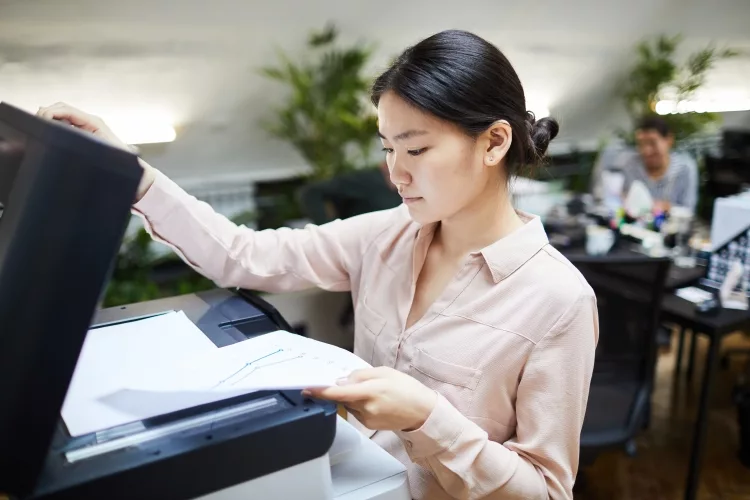
Below you'll find seven of the best document scanners for home use in 2026, covering everything from compact USB-powered portables to high-speed wireless desktop units. If you also need to handle oversized documents, check out our roundup of the best 11×17 scanners for larger-format needs.
Contents
Top Rated Picks of 2026
- #PreviewProductRating
- Bestseller No. 1
 Rating:

- Bestseller No. 2
 Rating:
 - Bestseller No. 3
 Rating:
 - Bestseller No. 4
 Rating:
 - Bestseller No. 5
 Rating:
 - Bestseller No. 6
 Rating:
 - Bestseller No. 7
 Rating:
In-Depth Reviews
1. Fujitsu ScanSnap iX1600 — Best Overall
The Fujitsu ScanSnap iX1600 is the gold standard for home document scanners in 2026, and it earns that title by being genuinely easy to use for everyone — even people who've never touched a scanner before. The large 4.3-inch color touchscreen walks you through every scan type with large, tappable buttons. You can set up custom scan profiles for different tasks (receipts, contracts, business cards) and launch them with a single tap. No fumbling through desktop software every time you want to scan.
Under the hood, it punches well above its consumer-grade appearance. You get up to 40 pages per minute (ppm) in duplex mode, a 50-sheet automatic document feeder (ADF — the tray that pulls pages through automatically), and 600 dpi (dots per inch) optical resolution. It connects over both USB and Wi-Fi, supports up to 30 individual user profiles, and integrates with cloud services like Google Drive, Dropbox, OneDrive, and Evernote out of the box. Multiple people can share this scanner on the same home network without any configuration headaches.
The ScanSnap Home software is where Fujitsu really pulls ahead. It automatically sorts scanned files, applies OCR (optical character recognition — turns your scanned images into searchable, editable text), and names files intelligently. If you scan a lot of receipts or important paperwork, this software alone saves you hours a month. For families or home offices with multiple users, the iX1600 is the one scanner that truly grows with you.
Pros:
- 40 ppm duplex scanning — fastest in its class for home use
- Large 4.3" touchscreen with one-tap custom profiles
- Supports up to 30 user profiles — ideal for shared households
- Wi-Fi + USB connectivity with broad cloud integration
- Excellent ScanSnap Home software with automatic OCR and file naming
Cons:
- Premium price point — the most expensive option on this list
- No flatbed glass — can't scan bound books or fragile documents
2. Epson Workforce ES-500W II — Best Wireless Scanner
If cutting the cord is your priority, the Epson Workforce ES-500W II delivers wireless scanning in a reliable, fast package. It connects directly to your home Wi-Fi network, and you scan from your smartphone or tablet using the Epson Smart Panel app — no laptop required. You can push scans straight to cloud accounts, email, or local folders from your phone. That's genuinely convenient when your computer is in another room.
Speed-wise, it hits 35 ppm / 70 ipm (images per minute, counting both sides of a page). The 50-sheet ADF handles mixed stacks of paper sizes and thicknesses without jams. Single-Step Technology scans both sides of every page in one pass, which cuts your total scan time nearly in half compared to scanners that flip the page. The 600 dpi optical resolution keeps text crisp and colors accurate for important documents and photos alike.
The Epson Smart Panel app is polished and intuitive. Scan previews appear immediately, you can crop or rotate before saving, and file naming is straightforward. One small caveat: wireless performance depends on your home network signal strength. If your router is in a different room with weak signal, you'll want to keep it USB-connected instead. Overall, for anyone who wants a fast, wireless-first scanner without the flagship price tag, this Epson is a compelling pick.
Pros:
- 35 ppm / 70 ipm — fast even by office scanner standards
- True wireless scanning from smartphones and tablets via Epson Smart Panel
- Single-Step duplex captures both sides in one pass
- 50-sheet ADF handles mixed paper types easily
- Broad cloud storage integration (Google Drive, Dropbox, OneDrive, etc.)
Cons:
- Wireless performance depends heavily on router proximity
- No touchscreen — setup is done through the app or PC software
3. HP ScanJet Pro 3600 f1 — Best Flatbed and ADF Combo
The HP ScanJet Pro 3600 f1 solves a real problem: you need to scan both stacks of loose documents and the occasional book, magazine page, or fragile photo. Most ADF-only scanners force you to improvise when something can't go through the feeder. This HP gives you a full flatbed glass surface plus a 60-page two-sided ADF in the same unit. That combination makes it the most versatile scanner on this list for mixed home office tasks.
The numbers are solid: 30 ppm / 60 ipm scanning speed, 600 dpi optical resolution, and a daily duty cycle (how many pages it's rated to handle per day) of up to 3,000 pages. That's serious capacity for home use. It also outputs to a wide range of file formats — PDF, JPEG, Word (DOC/DOCX), Excel (XLS/XLSX), and CSV — which means scanned text can go directly into editable documents without extra conversion steps.
The HP Smart software handles scanning from PC, Mac, or mobile. OCR accuracy is excellent, and the document management tools let you reorder pages, merge files, and send directly to email or cloud storage. If you've been frustrated by scanners that handle one thing well but fall apart on anything else, the 3600 f1 is built for exactly that real-world messiness. It's also worth noting that if you need TWAIN-compatible software workflows, check out our guide to the best TWAIN scanners — this HP supports the TWAIN standard fully.
Pros:
- Flatbed + ADF in one unit — handles books, photos, and loose paper stacks
- 60-page two-sided single-pass ADF — large capacity
- Outputs to Word, Excel, CSV for instant editable files
- Up to 3,000 pages daily duty cycle — built for heavy home use
- Full TWAIN driver support for document management software
Cons:
- Bulkier footprint than ADF-only models
- No wireless — USB connection only
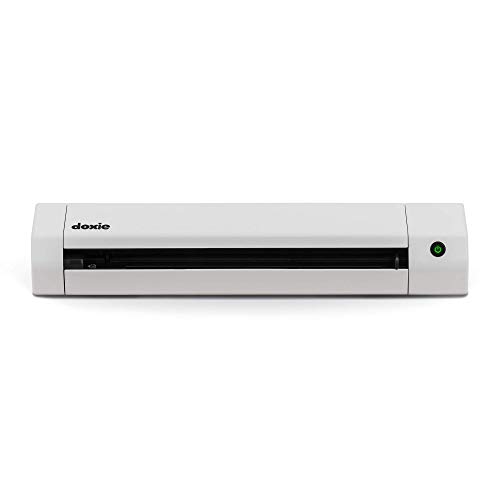
4. Doxie Go SE — Best Portable Scanner
The Doxie Go SE is the right scanner when you need scanning to happen anywhere — no desk, no outlet, no computer required. It's about the size of a rolled-up magazine, runs on a rechargeable battery, and has built-in memory to hold up to 8,000 pages before you need to sync. Drop it in your bag and scan documents at a client's office, a coffee shop, or while sorting through a storage unit full of old paperwork. It's the only scanner on this list that works completely offline.
Scan speed is 8 seconds per full-color page at up to 600 dpi — slower than any desktop model, but for a battery-powered portable, that's reasonable. One charge gets you up to 400 pages, which covers most real-world mobile scanning sessions. When you're back at your desk, sync over Wi-Fi (via an optional Wi-Fi SD card) or USB to the Doxie app on Mac or Windows. The software is clean and simple: organize, combine, and export to PDF, JPEG, or cloud services.
Where the Doxie Go SE makes trade-offs is clear: it has no ADF, so you feed pages one at a time. That works fine for a handful of receipts or contracts — it becomes tedious for a 50-page document. This is the niche tool you keep for portability and convenience, not the workhorse you run 200 pages through every week. If you want both portable scanning and printing in one device, also look at our list of the best portable scanner-printer combos.
Pros:
- Truly wireless and battery-powered — no outlet needed
- Stores up to 8,000 pages internally before syncing
- Up to 400 pages per charge
- Compact and genuinely portable — fits in any bag
- Straightforward Doxie software with cloud sync support
Cons:
- Manual single-sheet feeding — no ADF for stacks
- Slower scan speed (8 seconds/page) vs. desktop scanners
- Wi-Fi sync requires an optional Wi-Fi SD card
5. Epson Workforce ES-400 II — Best Budget Desktop Scanner
The Epson Workforce ES-400 II hits a sweet spot that many home users land in: you want a real desktop ADF scanner with good software, but you don't need Wi-Fi or a touchscreen. This one connects via USB and delivers fast, reliable duplex scanning at a lower price than the wireless ES-500W II. For a home office with a single dedicated computer, it's arguably the smarter buy.
The 50-sheet ADF handles mixed stacks without babysitting. Epson ScanSmart Software is one of the better bundled apps in this price range — it shows a live preview before you commit to saving, handles email attachments directly, uploads to cloud storage, and uses automatic file naming so you're not stuck renaming files manually. The included TWAIN driver means it plugs right into document management platforms like PaperPort or DocuWare if you use those at home.
Image adjustment tools are a genuine differentiator here. You get automatic color restoration for faded documents, dust removal, and background removal — useful when you're digitizing older paperwork or aging receipts. The tradeoff is a wired-only connection and no smartphone scanning unless your phone is connected to the same PC. For a solo user who scans at their desk, those omissions won't cost you anything. This is excellent value for what it delivers.
Pros:
- 50-sheet ADF handles mixed paper types and sizes
- Epson ScanSmart Software — live preview, auto file naming, cloud upload
- Image adjustment tools: color restoration, dust removal, background removal
- TWAIN driver included for document management software compatibility
- Lower price than wireless alternatives with similar scan quality
Cons:
- USB-only — no Wi-Fi or mobile scanning
- No flatbed surface for books or delicate originals
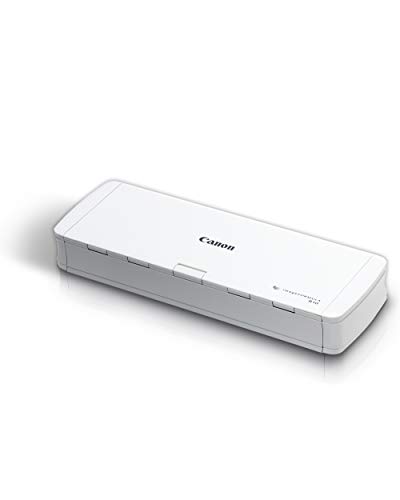
6. Canon imageFORMULA R10 — Best Ultra-Compact USB Scanner
The Canon imageFORMULA R10 is for the person who wants a real ADF document scanner that takes up almost no space and runs off a single USB cable — no wall outlet, no bulky power brick. It's lightweight enough to slip into a laptop bag alongside your computer. At home it sits on your desk without dominating it; on the road, it goes wherever you do. USB bus-powered scanners like this one are a completely different category from battery portables — you still need a laptop nearby, but the convenience factor is significant.
The R10 handles a wide range of document types that catch other compact scanners off guard: standard paper, receipts, business cards, plastic ID cards, and even embossed (raised-text) cards. That versatility matters for real home office tasks where you're not always scanning pristine 8.5×11 sheets. The Canon CaptureOnTouch Lite software runs directly from the scanner's internal memory without installing anything on your computer — plug in, scan, done. Output formats include searchable PDF and JPEG.
The suggested daily volume is 500 scans, which is honest and appropriate for this class of scanner. It's not built to chew through 1,000-page batches. But for someone going paperless at home — scanning a few dozen documents at a time — the R10 is practically perfect. Minimal footprint, maximum versatility, zero fuss.
Pros:
- USB bus-powered — no wall adapter needed
- Extremely compact and lightweight — laptop bag friendly
- Handles receipts, business cards, plastic cards, and embossed cards
- CaptureOnTouch Lite runs without PC installation
- Outputs searchable PDF and JPEG formats
Cons:
- Lower daily duty cycle (500 pages) — not for heavy batch scanning
- Requires a connected laptop or desktop — no standalone operation
7. Brother ADS-1800W — Best for Small Home Office
The Brother ADS-1800W sits in an interesting position: it's compact enough for a home desk but loaded with features you normally see in dedicated office units. The built-in 2.8-inch color touchscreen lets you control everything — scan type, destination, file format — without touching a computer. Connect via USB-C or Wi-Fi, and use the Brother Mobile Connect app to scan from your phone. It covers every connectivity option without requiring you to choose upfront.
Scan speed is 30 ppm with single-pass double-sided scanning and a 20-page ADF. The ADF is smaller than some competitors at this price, so if you regularly need to process large stacks at once, note that limitation. Where it compensates is in smart workflow automation: the bundled software can automatically sort, name, and route scanned files to cloud services, email, or local folders based on rules you set. Scan a receipt — it goes to your expense folder automatically. Scan a contract — it routes to your documents archive.
For a home office setup where you wear multiple hats and need scanning to just work without friction, the ADS-1800W delivers. It also excels at scanning mixed media — photos, receipts, and documents in the same batch. According to the Image Scanner Wikipedia entry, duplex ADF scanners like this one represent the modern standard for document digitization, and Brother's implementation here is genuinely competitive with units costing significantly more.
Pros:
- 2.8" color touchscreen for standalone operation
- USB-C and Wi-Fi connectivity plus mobile app support
- Automated workflow routing — rules-based file sorting and naming
- Single-pass duplex at 30 ppm — fast for its size
- Handles photos, receipts, and mixed media in the same batch
Cons:
- 20-page ADF is smaller than many competitors — frequent reloading for large jobs
- Workflow software has a learning curve to set up properly
What to Look For When Buying a Document Scanner for Home
ADF Capacity and Scan Speed
The automatic document feeder (ADF) tray is where you stack loose pages and let the scanner pull them through automatically. ADF capacity determines how long you can walk away between reloads. Most home scanners offer 20–60 sheet ADFs — the right size depends on your typical batch size. Scan speed is measured in ppm (pages per minute) for single-sided pages and ipm (images per minute) for both sides. For home use, 25–35 ppm is plenty. Only go higher if you regularly process hundreds of pages at once.
Connection Type: USB vs. Wi-Fi vs. Mobile
USB scanners are simpler, cheaper, and more reliable — if you always scan at the same desk connected to one computer, USB is the right call. Wi-Fi scanners let multiple people and devices share the scanner, and mobile apps mean you can scan directly to your phone. Wireless adds convenience but also adds complexity — connection drops and app updates are real friction points. Choose based on how you actually work, not the most impressive spec sheet.
OCR Quality and Software
OCR (optical character recognition) converts your scanned images into searchable, editable text. Not all bundled software handles this equally well. Look for scanners with OCR that:
- Creates searchable PDFs (you can use Ctrl+F to find words inside the file)
- Exports to editable formats like Word DOCX or Excel XLSX
- Handles handwritten notes (less common, but some do it)
- Auto-names files based on content or date
Fujitsu's ScanSnap Home and Epson's ScanSmart are the two best bundled software packages in 2026. Both are genuinely good, not just usable.
Flatbed vs. ADF-Only
ADF-only scanners are compact and fast but can't handle bound books, fragile originals, or anything that can't safely travel through the paper feed mechanism. A flatbed scanner has a glass surface you lay documents on — like a photocopier. Combo units (like the HP ScanJet Pro 3600 f1) give you both. If you ever scan photos, books, or non-standard documents, pay extra for a flatbed combo. If you only scan loose paper, an ADF-only model saves money and desk space.
Questions Answered
What resolution do I need for scanning documents at home?
For standard text documents, 300 dpi (dots per inch) is sufficient and keeps file sizes manageable. For documents with fine print, photos, or anything you might enlarge later, use 600 dpi. All seven scanners on this list offer 600 dpi optical resolution, which is the real hardware capability — avoid marketing claims about "enhanced" or "interpolated" dpi, which is software upscaling, not actual optical detail.
Can I scan to my phone without a computer?
Yes — several models on this list support direct-to-phone scanning without a PC involved. The Epson ES-500W II and Brother ADS-1800W both connect over Wi-Fi and use mobile apps to send scans directly to your phone. The Doxie Go SE stores scans internally and syncs to your phone later. The Canon R10 and Epson ES-400 II require a connected computer.
How many pages per day can a home scanner handle?
This is called the daily duty cycle, and it varies widely. The Canon R10 is rated for 500 pages per day — appropriate for light home use. The HP ScanJet Pro 3600 handles up to 3,000 pages daily, which suits heavier home office workloads. Most households scanning receipts, contracts, and occasional paperwork stay well under 500 pages per day. Match the duty cycle to your realistic usage, not your worst-case scenario.
Do document scanners work on Mac?
Yes. Every scanner on this list is compatible with both Windows and Mac. Epson's ScanSmart, Canon's CaptureOnTouch, HP Smart, and Fujitsu's ScanSnap Home all have native Mac versions. Some Wi-Fi scanners also work with macOS's built-in Image Capture app without installing any additional software, which is convenient if you prefer minimal third-party installs.
What's the difference between a document scanner and a flatbed scanner?
A document scanner typically refers to an ADF-equipped machine designed to process stacks of loose paper quickly. A flatbed scanner has a glass surface where you place individual items — ideal for photos, books, and fragile originals. Many modern scanners combine both features. If you need to scan non-standard items (bound books, photos, ID cards) regularly, look for a combo unit like the HP ScanJet Pro 3600 f1 or consider a dedicated flatbed for those tasks.
Is a 2026 document scanner worth buying over a multifunction printer with scanning?
Dedicated document scanners are significantly faster, produce better OCR results, and handle paper feeding more reliably than the scan functions built into all-in-one printers. If you scan more than a few pages a week, a dedicated scanner pays for itself in time saved. Multifunction printers make sense when printing is your priority and scanning is an occasional bonus. For serious home document digitization, a standalone scanner wins every time.
Buy on Walmart
- Fujitsu ScanSnap iX1600 ADF Scanner - 600 dpi Optical, White — Walmart Link
- Epson Workforce ES-500W II Wireless Color Duplex Desktop Doc — Walmart Link
- HP ScanJet Pro 3600 f1 Flatbed/ADF Scanner - 600 dpi Optical — Walmart Link
- Doxie Go SE - The Intuitive Portable Document Scanner with R — Walmart Link
- Epson Workforce ES-400 II Color Duplex Desktop Document Scan — Walmart Link
- Canon imageFORMULA R10 - Portable Document Scanner, USB Powe — Walmart Link
- Brother ADS-1800W Wireless Compact Desktop Scanner | Scan Sp — Walmart Link
Buy on eBay
- Fujitsu ScanSnap iX1600 ADF Scanner - 600 dpi Optical, White — eBay Link
- Epson Workforce ES-500W II Wireless Color Duplex Desktop Doc — eBay Link
- HP ScanJet Pro 3600 f1 Flatbed/ADF Scanner - 600 dpi Optical — eBay Link
- Doxie Go SE - The Intuitive Portable Document Scanner with R — eBay Link
- Epson Workforce ES-400 II Color Duplex Desktop Document Scan — eBay Link
- Canon imageFORMULA R10 - Portable Document Scanner, USB Powe — eBay Link
- Brother ADS-1800W Wireless Compact Desktop Scanner | Scan Sp — eBay Link
Key Takeaways
- The Fujitsu ScanSnap iX1600 is the best overall home document scanner in 2026 — fastest, smartest software, and the only model with a touchscreen that genuinely simplifies the experience for all household members.
- For wireless and mobile-first scanning, the Epson Workforce ES-500W II delivers the best combination of speed (35 ppm), app quality, and cloud integration at a mid-range price.
- If you scan anything beyond loose paper — books, photos, fragile documents — the HP ScanJet Pro 3600 f1 is the only model here that gives you a flatbed plus a high-capacity ADF in one unit.
- The Canon imageFORMULA R10 and Doxie Go SE are the right picks for portability: choose the R10 if you need a laptop-connected compact ADF, and the Doxie if you need to scan completely untethered from any computer.



About Remington May
Remington May is a technology writer and digital product reviewer with a focus on consumer electronics, software, and the everyday tech that shapes how people work and live. She has spent years evaluating smartphones, laptops, smart home devices, and digital tools — approaching each product from the perspective of a practical user rather than a spec-sheet enthusiast. At Pinwords, she covers tech buying guides, product reviews, smartphone and laptop comparisons, and practical how-to guides for getting more out of your devices.
Check for FREE Gifts. Or latest free books from our best messages.
Remove Ad block to reveal all the secrets. Once done, hit a button below