Best 35mm Film Scanner 2026
by Remington May
At its peak in the late 1990s, the world was shooting through roughly 80 billion frames of film per year — and the overwhelming majority of those negatives and slides are still packed away in drawers, shoeboxes, and dusty envelopes. If you're ready to rescue those memories (or your grandfather's travel slides from 1974), a dedicated 35mm film scanner is the right tool for the job. In 2026, the market has matured significantly, and the gap between consumer and professional-grade scanners is wider — and more consequential — than ever.
Choosing the wrong scanner can mean the difference between a crisp, print-ready 69-megapixel file and a muddy, color-shifted JPEG you'd be embarrassed to share. The options range from standalone plug-and-scan devices that require zero software knowledge to dedicated dedicated desktop scanners that rival lab-quality digitization. Your choice should be driven by the volume of film you're scanning, the output quality you need, and how much time you're willing to invest in post-processing. If you're also exploring other digitization and printing workflows, our guide to the best large format scanners covers complementary hardware worth pairing with your setup.
This guide covers seven of the best 35mm film scanners available in 2026, tested and ranked across image quality, software, ease of use, and overall value. Whether you're a hobbyist digitizing a single roll or a professional archiving thousands of frames, there's a right scanner on this list for you. We've also put together a full buying guide below to help you understand the key specs before you spend a dollar.

Contents
- Top Rated Picks of 2026
- In-Depth Reviews
- Plustek OpticFilm 8200i SE — Best Overall
- Plustek OpticFilm 135i Ai — Best Premium Pick
- Plustek OpticFilm 8100 — Best Budget Dedicated Scanner
- Plustek OpticFilm 8300i Ai — Best Mid-Range Pro
- Kodak SCANZA — Best Versatile Entry-Level
- KODAK Slide N SCAN — Best Large Display
- DIGITNOW 22MP — Best Standalone No-PC Option
- What to Look For When Buying
- Frequently Asked Questions
- Final Thoughts
Top Rated Picks of 2026
- #PreviewProductRating
- Bestseller No. 1
 Rating:

- Bestseller No. 2
 Rating:
 - Bestseller No. 3
 Rating:
 - Bestseller No. 4
 Rating:
 - Bestseller No. 5
 Rating:
 - Bestseller No. 6
 Rating:
 - Bestseller No. 7
 Rating:
In-Depth Reviews
1. Plustek OpticFilm 8200i SE — Best Overall
The Plustek OpticFilm 8200i SE has been the gold standard in the enthusiast film scanning space for years, and it continues to hold that title in 2026. At its core, this scanner delivers 7200 x 7200 dpi resolution — that's 69 megapixels for a full 35mm frame — which gives you enough detail to make sharp prints at 20 x 24 inches and beyond. The 48-bit color depth means you're capturing a massive tonal range from your negatives, and the output is clean enough for professional use in both archival and editorial contexts.
What really separates the 8200i SE from cheaper alternatives is its built-in infrared channel for dust and scratch detection. This iSRD (infrared Smart Removal of Defect) technology reads the physical surface of your film, identifies imperfections, and removes them digitally — without any resampling or blurring of actual image detail. For anyone working through older, less-than-pristine negatives, this feature alone justifies the price premium. The bundled SilverFast SE Plus 9 software is legitimately professional-grade: it gives you full control over color profiles, multi-exposure settings, and batch scanning workflows.
The Enhanced Multi-Exposure function is worth calling out specifically. It scans each frame multiple times at different exposure settings and combines the results to pull detail out of the deepest shadows and brightest highlights — pushing the effective dynamic range up to 3.6 Dmax. This scanner also offers full 64-bit hardware and software support, which means it integrates cleanly with modern Mac and Windows systems without driver headaches. If you're serious about digitizing your film and you want results that can stand next to a lab scan, this is your scanner.
Pros:
- 7200 dpi / 69 MP resolution delivers genuinely lab-quality scans
- Built-in infrared dust and scratch removal works without degrading sharpness
- Multi-Exposure function for superior dynamic range (3.6 Dmax)
- SilverFast SE Plus 9 is a full professional software suite
- Supports both Mac and PC, 64-bit compatible
Cons:
- Slower throughput than the newer 8300i Ai — not ideal for high-volume batch work
- SE Plus software is powerful but has a steeper learning curve than plug-and-scan tools
2. Plustek OpticFilm 135i Ai — Best Premium Pick
Launched in 2025 and hitting its stride in 2026, the Plustek OpticFilm 135i Ai is the most capable 35mm film scanner you can buy for home or studio use right now. It's built around a third-generation five-element lens system — a significant engineering upgrade over previous OpticFilm models — designed specifically to reduce light refraction and keep image sharpness consistent all the way to the edges of the frame. That matters enormously when you're scanning slides with detail in the corners, or when your negatives have been slightly bent over decades of storage.
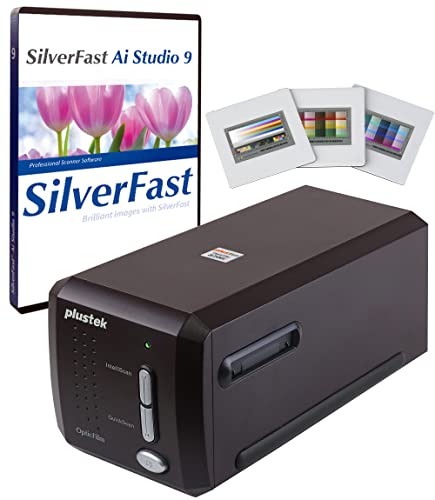
The infrared quality enhancement is where this scanner truly sets itself apart. The five-glass lens elements minimize IR image plane defocus issues, which is a persistent problem on many competitors' designs. Plustek claims up to a 200% MTF boost compared to prior optics, and the iSRD dust and scratch removal performance is measurably better as a result — you'll see fewer artifacts and more accurate defect detection even on dense slide film. The bundled SilverFast Ai Studio 9 is the top tier of the SilverFast line, significantly more capable than the SE Plus version included with the 8200i SE, with full multi-image batch processing, HDR raw workflows, and an expanded color management toolset.
Included with the 135i Ai is an Advanced IT8 Calibration Target — a 3-slide calibration kit that conforms to ISO 12641-2 (2019) standards. This lets you profile the scanner to your specific film stock and lighting conditions with far more measuring points than a standard IT8 target, which means the colors in your final scans are as accurate as physically possible. If you're a professional photographer archiving client work, a dedicated film archivist, or simply someone who will not compromise on quality, the 135i Ai is the definitive 2026 choice. It costs more, but you're buying generational optical engineering in a scanner form factor.
Pros:
- 3rd-generation 5-element lens with superior edge sharpness and IR performance
- MTF boosted up to 200% over prior Plustek optics for infrared defect removal
- Bundled SilverFast Ai Studio 9 — the most powerful version available
- Advanced IT8 Calibration Target (3 slides) included for precise color profiling
- 2025 hardware with future-proof firmware support
Cons:
- Premium price point — a significant investment over the 8200i SE or 8300i Ai
- SilverFast Ai Studio has a complex interface that casual users may find overwhelming
3. Plustek OpticFilm 8100 — Best Budget Dedicated Scanner
If you want the core OpticFilm experience without paying for infrared dust removal, the Plustek OpticFilm 8100 delivers the same 7200 DPI / 69 megapixel resolution as its pricier siblings at a meaningfully lower price point. This is the scanner you buy when your negatives are in decent shape, you don't mind doing a pass in Lightroom or Photoshop to clean up the occasional dust spot, and you want professional-quality output without the premium accessory stack. The resolution is genuinely impressive — equivalent to a 69-megapixel full-frame DSLR capture — and the 48-bit output gives you serious dynamic range latitude in post.
The bundled software is SilverFast SE Plus 9 alongside Plustek's own QuickScan, which gives you two workflow options: the fast, guided QuickScan path for simple batch digitizing, or the full SilverFast environment for manual control over color profiles, exposure, and sharpening. For anyone new to dedicated film scanning, this pairing is genuinely useful. QuickScan gets you scanning within minutes; SilverFast grows with your skills. The shadow and highlight detail capture is strong across the 3.4 Dmax dynamic range spec — you'll pull detail out of well-exposed negatives that cheaper scanners simply clip.
The trade-off is obvious: no iSRD infrared channel means any dust or scratches on your film surface need to be addressed manually, either with a cleaning routine before scanning or digital retouching after. For archiving well-maintained film collections, this is a perfectly acceptable trade-off. For older film in rough condition, step up to the 8200i SE or 8300i Ai. Otherwise, the 8100 represents the best value in dedicated 35mm film scanning in 2026 for users who prioritize resolution over automated defect correction. If you're also interested in digitizing documents alongside film, our best portable scanners for Mac roundup pairs well with this setup.
Pros:
- Same 7200 DPI / 69 MP resolution as the 8200i SE at a lower price
- 48-bit color output for full post-processing flexibility
- QuickScan + SilverFast SE Plus 9 dual software bundle suits both beginners and advanced users
- Mac and Windows compatible
Cons:
- No infrared dust and scratch removal — manual cleaning or retouching required
- Slightly lower Dmax (3.4) than the 8200i SE (3.6)
4. Plustek OpticFilm 8300i Ai — Best Mid-Range Pro
The Plustek OpticFilm 8300i Ai slots in between the 8200i SE and the premium 135i Ai — and in many ways it's the most well-rounded scanner in the entire OpticFilm lineup. Plustek's new-generation chip delivers a 38% scan speed increase over the previous model, which is a real-world difference you'll notice immediately when processing a batch of 36-exposure rolls. It scans negatives and slides at the same 7200 DPI resolution as the rest of the OpticFilm family, and the infrared dust and scratch removal is present and fully functional, so you're getting the complete toolkit.
The software bundle here is genuinely impressive: you get SilverFast Ai Studio 9 (the same top-tier version included with the 135i Ai) plus Plustek QuickScan Plus. SilverFast Ai Studio carries over 100 advanced imaging functions including HDR raw capture, multi-exposure blending, selective color correction, and full batch automation. For photographers who want the most control over their scan output without moving up to the optical premium of the 135i Ai, this is the configuration to choose. The dual-software approach means you can automate repetitive work through QuickScan Plus and drop into full manual control whenever a difficult negative demands it.
Also included are three Advanced IT8 Calibration Target slides — a $99 value bundled in at no extra cost. These bring the 8300i Ai's color calibration accuracy in line with much more expensive archival scanners. If speed, infrared correction, and professional software matter more than bleeding-edge optics, the 8300i Ai hits a very satisfying middle ground in 2026. It's the scanner we'd recommend to anyone who scans more than a few rolls a month and wants results that eliminate the need for a scanning service.
Pros:
- 38% faster than previous generation — real throughput advantage for batch scanning
- Infrared dust and scratch removal included
- SilverFast Ai Studio 9 + QuickScan Plus — the strongest dual-software bundle in its class
- IT8 Calibration Target (3 slides) included — $99 value at no extra cost
Cons:
- Optics don't match the newer 3rd-generation lens in the 135i Ai
- Higher price than the 8200i SE for a feature set that's largely comparable for casual users
5. Kodak SCANZA — Best Versatile Entry-Level
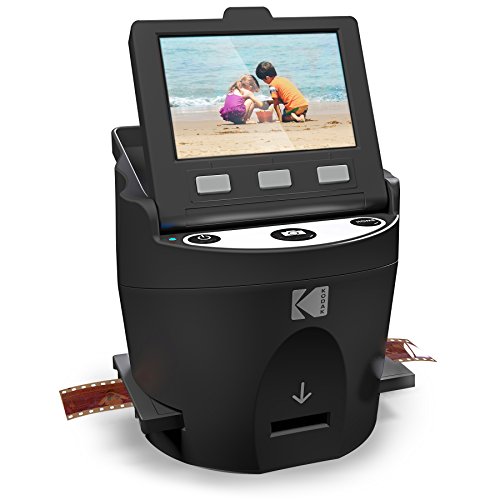
The Kodak SCANZA takes a completely different approach from the Plustek lineup, and it's built for a completely different buyer. This is a standalone device that converts film directly to JPEG in seconds, without needing a computer, specialized software, or any technical knowledge. If you've got a mixed collection of old film formats — 35mm, 126, 110, Super 8, and 8mm — and you just want to get them digitized quickly without a steep learning curve, the SCANZA handles all of them with the included adapters and easy-load inserts.
The built-in 3.5-inch TFT LCD screen is bright and readable, and the adjustable brightness plus tilt make it easy to preview your scans before committing them to storage. The one-touch scanning interface is genuinely as simple as it sounds — load the film, press the button, scan is saved. Output resolution is 14/22MP, which is sufficient for sharing online, printing up to 8x10 at standard viewing distances, and preserving the memory content of your photos. What the SCANZA is not is a professional archival tool. The 14/22MP output via software interpolation doesn't come close to matching the optical resolution of the Plustek dedicated scanners, and there's no dynamic range enhancement or dust removal.
For the right buyer — someone with a few rolls to digitize, no desire to learn SilverFast, and a budget that doesn't stretch to a dedicated film scanner — the SCANZA is a perfectly competent solution. It's also worth considering if you need to digitize unusual formats like Super 8 that the Plustek scanners don't support. According to Wikipedia's overview of film scanners, dedicated drum and flatbed scanners are still the gold standard for archival work, but consumer devices like the SCANZA have dramatically lowered the barrier to basic film digitization.
Pros:
- Supports 35mm, 126, 110, Super 8, and 8mm — the widest format compatibility on this list
- Completely standalone — no computer or software required
- Large 3.5" LCD with adjustable brightness and tilt for easy preview
- One-touch scanning makes it accessible to anyone
Cons:
- 14/22MP interpolated output — not a match for dedicated optical scanners
- No dust/scratch removal, no dynamic range enhancement
- JPEG-only output limits post-processing flexibility
6. KODAK Slide N SCAN — Best Large Display
The KODAK Slide N SCAN upgrades the SCANZA formula in one significant way: a 5-inch crystal-clear LCD display with a wide viewing angle that makes it feel less like a utility device and more like an interactive photo station. That large screen isn't just for scanning — it doubles as a gallery mode viewer, letting you browse your digitized photos directly on the unit. This makes the Slide N SCAN a particularly appealing choice for family gatherings where you're digitizing old slides and want to share them on-screen in real time without connecting to a TV or computer.
The quick-feeding tray system supports continuous loading, which speeds up the process considerably compared to single-frame scanners. Supported formats include 135, 110, and 126 film plus 50mm slides — a solid lineup, though it doesn't cover Super 8 or 8mm like the SCANZA does. Output is up to 22MP saved directly to an SD card (not included), and an HDMI cable is bundled in so you can output to a television for group viewing. The included cleaning brush is a small but thoughtful touch that helps reduce dust artifacts without any additional purchase.
Like the SCANZA, the Slide N SCAN's 22MP is software-interpolated, not optically derived — so you're not getting the resolving power of a dedicated scanner. But for casual family archiving, the combination of the large display, easy loading system, and HDMI output makes this a genuinely user-friendly experience. If your priority is sharing memories with non-technical family members while the digitization happens, you won't find a more approachable device on this list. Pair it with a quality editing setup — our guide to the best laptops for photo editing under $1000 covers the software side of your post-processing workflow.
Pros:
- 5-inch wide-viewing-angle LCD — the largest display in this roundup
- Gallery mode for on-device photo browsing and HDMI output to TV
- Quick-feeding tray for faster continuous scanning sessions
- Cleaning brush included in the box
Cons:
- No Super 8 or 8mm support unlike the SCANZA
- 22MP is interpolated — optical resolution doesn't match dedicated scanners
- SD card not included
7. DIGITNOW 22MP All-in-1 — Best Standalone No-PC Option
The DIGITNOW 22MP All-in-1 Film Scanner is the most format-flexible device in this roundup, covering 35mm/135, 110, 126KPK, and Super 8 films, slides, and negatives. It operates completely standalone — no computer, no software installation, no driver conflicts. A scan completes in approximately two seconds, and the output goes directly to an SD card (up to 32GB, sold separately) as a color or black-and-white JPEG file. The built-in 128MB memory provides a small buffer if you don't have an SD card immediately available, though you'll want to use one for any serious session.
The 2.4-inch LCD screen is on the smaller side compared to the Kodak options, but it's functional for previewing and basic brightness or color adjustments before committing to a save. With software interpolation, the unit outputs files up to 22 megapixels — the same specification as the KODAK Slide N SCAN. Realistically, this is useful for digital sharing and modest print sizes, but it's not the tool you'd choose for exhibition-quality archiving. What the DIGITNOW does exceptionally well is remove every possible barrier between you and a digitized photo.
There's no software to learn, no USB driver to install, no computer to sit next to. You can scan an entire roll while sitting on your couch. For elderly family members who've been meaning to digitize a lifetime of slides but are intimidated by technology, this is the scanner to give them. The build quality is consumer-grade — don't expect it to last a decade of heavy professional use — but for a once-through archival project on a tight budget, it delivers on its core promise reliably and without friction.
Pros:
- Widest format support: 35mm/135, 110, 126KPK, and Super 8
- Truly standalone — no computer, no software, no drivers required
- 2-second scan speed with built-in 128MB buffer memory
- Brightness and color adjustable on-device before saving
Cons:
- 2.4-inch screen is small for comfortable previewing
- 22MP is software-interpolated, not optical resolution
- SD card not included; build quality reflects the entry-level price
What to Look For When Buying a 35mm Film Scanner
Optical Resolution vs. Interpolated Resolution
This is the single most important specification to understand before you buy. Optical resolution is the actual resolving power of the scanner's sensor and lens system — the real number of distinct pixels it can capture from your film. Interpolated resolution is a software-generated estimate that fills in detail the hardware never actually recorded. The Plustek OpticFilm scanners in this guide are rated at 7200 DPI optically. The consumer Kodak and DIGITNOW devices advertise 22MP, but that figure comes from software interpolation of a much lower optical capture. For archival work, family photo preservation at print-quality resolution, or any use case where you might want to revisit the files in 10 years, optical resolution is the only number that matters. Don't let interpolated megapixel counts mislead you into thinking you're getting equivalent quality to a dedicated optical scanner.
Infrared Dust and Scratch Removal (iSRD)
Film picks up dust and scratches over time — it's unavoidable with older negatives and slides. Dedicated scanners like the Plustek 8200i SE, 8300i Ai, and 135i Ai have a built-in infrared channel that reads the physical surface of the film separately from the image data, identifies defects, and removes them digitally without blurring or distorting actual image content. This is a genuinely game-changing feature when you're working through decades-old film. Consumer plug-and-scan devices don't have this capability — they'll faithfully digitize every piece of dust and every scratch on your negatives. If you're scanning pristine, well-maintained film, you can skip it. If you're working through family archives from the 1970s and 1980s, iSRD will save you hours of manual retouching. Also worth exploring as part of your broader document digitization setup: our best duplex scanner guide covers high-speed document scanning that pairs well with a dedicated film scanner workflow.
Dynamic Range (Dmax)
Dynamic range in film scanning is measured as Dmax — the maximum optical density a scanner can capture. A higher Dmax means the scanner can pull detail from the darkest shadows on your negatives or the brightest highlights on your slides. Entry-level flatbed scanners typically top out around 2.8–3.0 Dmax. The Plustek OpticFilm 8100 achieves 3.4, while the 8200i SE reaches 3.6 with its Enhanced Multi-Exposure function. The difference shows up clearly in the shadow regions of dense slide film — a low-Dmax scanner clips those areas to pure black, while a high-Dmax scanner retains gradients and texture. For slide film in particular, which tends to have a wider contrast range than negative film, Dmax matters a great deal.
Software: What's Bundled and Why It Matters
The scanning hardware is only half the equation. SilverFast — developed by LaserSoft Imaging — is the professional standard in film scanning software, and the version bundled with your scanner makes a meaningful difference in what you can achieve. SilverFast SE Plus (bundled with the 8100 and 8200i SE) gives you a robust set of controls for color correction, multi-exposure blending, and batch scanning. SilverFast Ai Studio (bundled with the 8300i Ai and 135i Ai) adds HDR raw workflows, more advanced color profiling tools, and a more comprehensive batch automation system. If you plan to scan more than a few rolls and want the best possible color accuracy from your negatives, the Ai Studio bundle is worth the extra investment. Consumer devices that ship without SilverFast — or with bare-bones software — leave significant quality on the table regardless of the hardware specs.
Frequently Asked Questions
What is the best 35mm film scanner for beginners in 2026?
The Kodak SCANZA or KODAK Slide N SCAN are the best starting points for beginners. Both operate completely standalone without any software knowledge required — you load the film, press a button, and the scan saves to your SD card. If you want better image quality and are willing to learn basic software, the Plustek OpticFilm 8100 is the best entry into dedicated optical scanning, and the QuickScan software included with it is straightforward enough for new users to get scanning within minutes.
Do I need special software to use a film scanner?
Dedicated optical scanners like the Plustek OpticFilm series require scanning software — SilverFast or QuickScan — to operate. These are bundled with the scanner at no additional cost, but you do need to install them on your Mac or Windows computer. Consumer plug-and-scan devices like the SCANZA and Slide N SCAN are fully self-contained and require no software or computer at all, saving directly to an SD card.
What does 7200 DPI mean for a film scanner?
DPI stands for dots per inch — it's the measurement of how much detail the scanner captures per inch of film. At 7200 DPI, a 35mm frame (which is approximately 1.4 x 1 inch) is digitized at roughly 69 megapixels. That's enough resolution to produce sharp photographic prints at 20 x 24 inches and to crop heavily into an image without losing sharpness. In practical terms, 7200 DPI from a dedicated optical scanner like the Plustek OpticFilm captures more true image detail than most full-frame digital camera sensors produce in a single shot.
Can these scanners handle slide film as well as negatives?
Yes. All seven scanners in this guide support both 35mm color and black-and-white negative film as well as mounted slides. The Plustek OpticFilm series handles both formats through the same hardware with different scanning profiles in SilverFast. The consumer Kodak and DIGITNOW devices include separate adapters for slides and negatives. Slide film generally has higher contrast than negative film, so the Dmax spec matters more for slides — the Plustek scanners' higher dynamic range gives you noticeably better results with dense slide film.
How long does it take to scan a roll of 35mm film?
Scan time depends heavily on the resolution setting and whether you're using features like Multi-Exposure or infrared defect removal. At maximum quality settings on a Plustek OpticFilm 8300i Ai, a single frame takes approximately 30–90 seconds to scan. A full 36-exposure roll at high quality can take 30–60 minutes on a dedicated scanner. Consumer plug-and-scan devices like the SCANZA and DIGITNOW complete each frame in 2–5 seconds, making them much faster — but at the cost of optical resolution and image quality.
Is it worth scanning film at home or should I use a lab service?
It depends on your volume and quality requirements. Lab scanning services charge anywhere from $15 to $40 per roll for quality digital scans, which adds up quickly if you have dozens of rolls to process. A one-time investment in a Plustek OpticFilm scanner pays for itself after 20–40 rolls compared to a lab service, and you retain full control over the scanning parameters. For a single roll of sentimental photos, a lab may be simpler. For an ongoing hobby or a significant family archive, home scanning is the more practical and cost-effective long-term solution.
Buy on Walmart
- Plustek OpticFilm 8200i SE , 35mm Film & Slide Scanner. 7200 — Walmart Link
- Plustek OpticFilm 135i Ai - Pro-Quality Film & Slide Scanner — Walmart Link
- Plustek OpticFilm 8100-35mm Negative Film/Slide Scanner with — Walmart Link
- Plustek OpticFilm 8300i Ai Film Scanner - Converts 35mm Film — Walmart Link
- Kodak SCANZA Digital Film & Slide Scanner – Converts 35mm, 1 — Walmart Link
- KODAK Slide N SCAN Film & Slide Scanner Digitizer with 5” LC — Walmart Link
- DIGITNOW 22MP All-in-1 Film & Slide Scanner, Converts 35mm 1 — Walmart Link
Buy on eBay
- Plustek OpticFilm 8200i SE , 35mm Film & Slide Scanner. 7200 — eBay Link
- Plustek OpticFilm 135i Ai - Pro-Quality Film & Slide Scanner — eBay Link
- Plustek OpticFilm 8100-35mm Negative Film/Slide Scanner with — eBay Link
- Plustek OpticFilm 8300i Ai Film Scanner - Converts 35mm Film — eBay Link
- Kodak SCANZA Digital Film & Slide Scanner – Converts 35mm, 1 — eBay Link
- KODAK Slide N SCAN Film & Slide Scanner Digitizer with 5” LC — eBay Link
- DIGITNOW 22MP All-in-1 Film & Slide Scanner, Converts 35mm 1 — eBay Link
Final Thoughts
The right 35mm film scanner in 2026 comes down to one honest question: how much does the final image quality matter to you? If you want professional-grade results that rival a lab scan, the Plustek OpticFilm 8200i SE is your starting point and the 135i Ai is your ceiling — both deliver optical resolution and dynamic range that consumer devices simply cannot match. If you just want to rescue a box of old slides without any technical friction, the Kodak SCANZA or Slide N SCAN will get the job done in minutes. Pick the scanner that matches your actual use case, check the current prices linked above, and start bringing those memories back to life.



About Remington May
Remington May is a technology writer and digital product reviewer with a focus on consumer electronics, software, and the everyday tech that shapes how people work and live. She has spent years evaluating smartphones, laptops, smart home devices, and digital tools — approaching each product from the perspective of a practical user rather than a spec-sheet enthusiast. At Pinwords, she covers tech buying guides, product reviews, smartphone and laptop comparisons, and practical how-to guides for getting more out of your devices.
Check for FREE Gifts. Or latest free books from our best messages.
Remove Ad block to reveal all the secrets. Once done, hit a button below