Best Screen Printing Ink 2026
by Remington May
Which screen printing ink actually delivers professional results — and which ones wash out, crack, or bleed after a few cycles? If you've been sorting through dozens of options, Speedball Fabric Screen Printing Ink consistently rises to the top for beginners and pros alike. But the right ink depends entirely on your substrate, curing setup, and print volume. This guide cuts through the noise.
Screen printing is a precise craft. The ink you choose affects opacity, hand feel, cure temperature, wash durability, and the kind of press you need. In 2026, the market splits cleanly between water-based inks — better for eco-conscious shops and fine detail — and plastisol inks, the industry workhorse for vibrant, durable prints on cotton and blended garments. Discharge inks occupy a specialized third lane, pulling dye out of the fabric for an ultra-soft, dyed-in result on dark substrates.
Whether you're outfitting a home studio or scaling a print shop, the seven products reviewed here represent the best options across every major category. Each was evaluated on coverage, ease of use, cure requirements, and value per ounce. If you're also exploring related printing methods, our guides on best plastisol ink and best sublimation ink cover adjacent techniques in depth. Read through the buying guide section before purchasing — matching ink type to your workflow saves money and frustration.
Contents
- Standout Models in 2026
- Full Product Breakdowns
- Speedball Fabric Screen Printing Ink — Best Overall
- Jacquard Professional Screen Print Ink — Best Water-Based for Paper
- Permaset Aqua Fabric Printing Ink — Best Eco-Friendly White
- Ecotex® Discharge White — Best Discharge Ink
- Just So Soft Black Plastisol Ink — Best Soft-Hand Plastisol
- Rapid Cure® 6-Color Plastisol Ink Set — Best Starter Kit
- Avalanche White Plastisol Ink — Best High-Volume White
- Key Features to Consider When Choosing
- FAQs
- Next Steps
Standout Models in 2026
- #PreviewProductRating
- Bestseller No. 1
 Rating:

- Bestseller No. 2
 Rating:
 - Bestseller No. 3
 Rating:
 - Bestseller No. 4
 Rating:
 - Bestseller No. 5
 Rating:
 - Bestseller No. 6
 Rating:
 - Bestseller No. 7
 Rating:

Full Product Breakdowns
1. Speedball Fabric Screen Printing Ink, 8-Ounce, Black — Best Overall
Speedball has been a go-to name in printmaking for decades, and this water-based black fabric ink justifies that reputation. It works across cotton, polyester, linen, rayon, and blends — a versatility that makes it the logical first purchase for any screen printer building out a supply kit. Coverage is consistent pass after pass, with minimal pinholes even through higher mesh counts. The ink pulls cleanly through the screen without clogging or drying prematurely mid-run.
The hand feel after heat setting is notably soft. Once cured with a heat press or iron at the manufacturer's recommended temperature, the print bonds permanently to the fabric fibers without stiffening the garment. This ink also performs on paper and cardboard, which expands its usefulness beyond apparel into packaging and art prints. Cleanup is straightforward with water before the ink cures — a clear advantage over solvent-based alternatives.
For beginners, the 8-ounce size is a practical entry point: enough to print a meaningful run without committing to a bulk container before you've dialed in your screens and squeegee pressure. Experienced printers use it for black on light garments where a water-based finish is preferred over plastisol's heavier feel.
Pros:
- Broad fabric compatibility including synthetics and natural fibers
- Super-soft hand feel after proper heat cure
- Water cleanup before curing — no solvents required
- Consistent workability across extended print runs
- Also works on paper and cardboard
Cons:
- 8-ounce size runs out quickly on larger production runs
- Requires precise heat setting — undercured prints will wash out

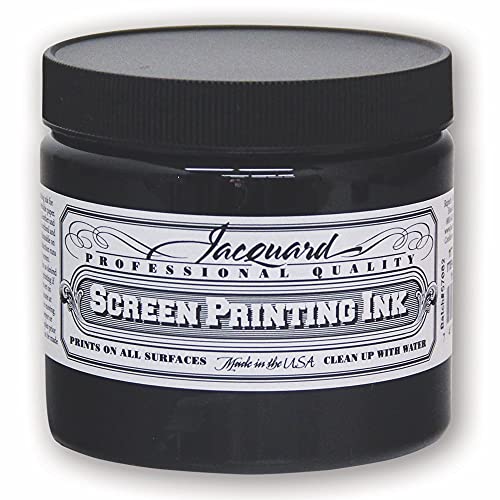
2. Jacquard Professional Screen Print Ink, Water-Soluble, 16oz Jar, Black — Best Water-Based for Paper
Jacquard targets the professional and fine-art printmaker with this 16-ounce water-based formula. The distinguishing spec here is archival quality: this ink is rated lightfast and archival, making it the correct choice when your prints need to survive years of display without fading. That positions it squarely in the fine-art print, poster, and limited-edition reproduction category where Speedball's more utility-focused formula may not suffice.
Coverage is superior on paper substrates. The semi-gloss finish dries scuff-proof and won't buckle or curl paper, which is a genuine problem with thinner water-based inks that oversaturate the substrate. Detail reproduction is sharp — fine lines and halftone dots hold cleanly, which matters for illustrators and photographers reproducing complex artwork through a screen.
The 16-ounce jar delivers real value for production quantities. On fabric, it performs well but is most at home on paper, cardstock, and rigid substrates. The water-soluble cleanup keeps studio operations clean and ventilation requirements minimal. If your work skews toward art prints and you want longevity in your output, Jacquard is the professional specification to reach for in 2026.
Pros:
- Archival and lightfast — suitable for fine-art print editions
- Semi-gloss finish is scuff-proof and durable
- Excellent detail and coverage on paper substrates
- Won't buckle or curl paper
- 16-ounce jar reduces per-print cost on production runs
Cons:
- Optimized for paper — fabric performance trails specialized fabric inks
- Higher price point than basic water-based options
3. Permaset Aqua 300ml Fabric Printing Ink, Standard White — Best Eco-Friendly White
Permaset Aqua is an Australian-formulated water-based ink with a strong reputation in sustainable textile printing. The Standard White variant delivers deep, lasting opacity on fabric — an achievement that stumps many water-based white inks, which tend to be translucent and require multiple passes. Permaset's formulation holds color saturation across multiple washes without cracking or peeling, which field testing confirms as a genuine differentiator versus cheaper water-based whites.
The ink's versatility is notable: it performs on fabric, cardstock, paper, and even glass when combined with appropriate techniques. Printers report clean results using both screen and block printing methods, giving it broader studio utility. The 300ml container is sized for experimental and moderate production use rather than high-volume commercial runs.
Environmental credentials matter to a growing segment of the print market. Permaset inks carry OEKO-TEX certification and are formulated without PVC, phthalates, or heavy metals. If you're printing for clients who audit supply chains or building a brand on sustainable manufacturing, this certification is a concrete selling point. The consistency from batch to batch is reliable, which matters when matching colors across separate production runs.
Pros:
- OEKO-TEX certified — free from PVC, phthalates, and heavy metals
- Strong white opacity for a water-based formula
- Works on fabric, paper, cardstock, and glass surfaces
- Compatible with screen and block printing techniques
- Consistent batch-to-batch color matching
Cons:
- 300ml size limits large production runs without multiple containers
- Premium eco-certification comes at a higher per-ounce cost
4. Ecotex® Screen Printing Ink Discharge White (8oz.) — Best Discharge Ink
Discharge printing is a fundamentally different technique from conventional screen printing. Instead of depositing ink on top of the fabric, discharge inks use a chemical activator to remove the dye from the fiber and replace it with pigment — the result is a print that is literally part of the fabric, not a layer sitting on top of it. Ecotex Discharge White delivers the ultra-soft, no-hand-feel result that discharge printing is known for, on garments where conventional inks would add a detectable layer.
This ink is ready to use directly from the container or can be mixed with a discharge activator for enhanced results on deeply dyed fabrics. Screen Print Direct manufactures this product in the USA, and the formulation is water-based — a practical advantage for shops managing waste disposal and ventilation. The 8-ounce size is a logical test quantity before committing to larger volumes, particularly since discharge printing requires a learning curve around activator ratios and cure conditions.
Discharge white is most effective on reactive-dyed cotton garments — 100% ring-spun cotton in dark colorways. It does not work predictably on polyester, pigment-dyed garments, or fabrics with chemical finishes. Printers who have mastered discharge technique consistently report it as the superior method for soft-hand prints on premium blanks. The investment in learning the process pays off in print quality that water-based or plastisol layering cannot replicate.
Pros:
- Produces zero-hand-feel prints — the softest result in screen printing
- Ready to use directly from container
- USA manufactured, water-based formulation
- Ideal for premium blanks and fashion-forward print shops
Cons:
- Only effective on reactive-dyed 100% cotton — no polyester compatibility
- Requires activator mixing knowledge and specific cure conditions
- Learning curve is steeper than conventional inks
5. Plastisol Ink for Screen Printing, Quart — Just So Soft Black — Best Soft-Hand Plastisol
The conventional critique of plastisol ink — that it prints stiff and heavy on fabric — does not apply here. Just So Soft Black is engineered specifically for a low-viscosity, soft-hand result while maintaining the vibrant, semi-opaque coverage that makes plastisol the commercial standard. On light to medium colored 100% cotton garments, it delivers prints that drape naturally with the fabric rather than sitting as a rigid layer on top of it.
The quart size positions this product for intermediate and professional production environments. A quart of plastisol goes a long distance on standard print runs, and the consistent viscosity across the container means your last print of the day matches your first. No underlay is required on light to medium garments, which simplifies your print setup and reduces cycle time per shirt.
Plastisol inks require a heat cure — typically 320°F (160°C) — to achieve full bond strength and wash durability. Unlike water-based inks, plastisol won't dry in the screen during a run, which is a significant practical advantage for larger batches. The ink can be left in an open screen without damage, and cleanup uses plastisol ink remover rather than water. If you're working primarily on cotton apparel and want a black that prints vividly without sacrificing softness, this is the specification to choose.
Pros:
- Soft-hand result — significantly less stiff than standard plastisol
- Semi-opaque with vivid, eye-catching color output
- No underlay required on light to medium garments
- Won't dry in screen during runs — open time advantage
- Quart size suits production volume printing
Cons:
- Requires dedicated plastisol remover for cleanup — no water cleanup
- Needs flash cure unit or conveyor dryer — iron curing is unreliable
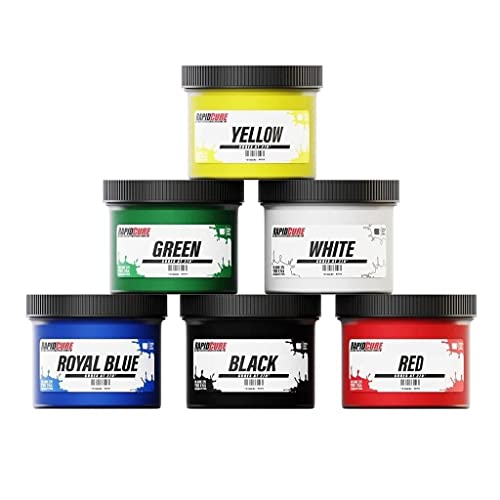
6. Screen Printing Ink Set — Rapid Cure® 6-Color Plastisol Ink by Screen Print Direct — Best Starter Kit
Buying a single color is efficient when you know your palette. But if you're building a screen printing setup from scratch in 2026, the Rapid Cure 6-Color Plastisol Ink Set gives you a working color library in a single purchase. The low-temperature cure formulation is the defining technical feature — these inks flash and cure at lower temperatures than standard plastisol, reducing the energy requirement and giving you more forgiveness with entry-level heat equipment like heat guns and lower-end flash units.
Six 8-ounce jars cover primary colors plus white and black, giving you the foundation to mix a wide range of custom colors. The ink set ships non-toxic with low odor, making it suitable for home studios and classrooms where ventilation is limited. Screen Print Direct manufactures this in the USA, and the formula is rated for cotton, linen, polyester, blends, and vinyl substrates — the broadest compatibility in this review group.
The permanent, vibrant finish holds up through repeated wash cycles without cracking or fading when properly cured. For a printer learning the craft, this set eliminates the need to source individual colors from multiple suppliers. It also functions as a reliable production kit for smaller print shops handling short-run custom orders across diverse color requests. If you're also working with digital output tools for design, our best tablet for Adobe Illustrator guide covers companion tools worth knowing about.
Pros:
- Low-temperature cure — more forgiving with entry-level heat equipment
- 6-color set covers primary palette plus white and black
- Non-toxic, low odor — safe for home and classroom use
- Works on cotton, polyester, blends, linen, and vinyl
- USA manufactured by established specialty supplier
Cons:
- 8-ounce jars deplete quickly on higher-volume production runs
- Color mixing requires experience to achieve precise custom shades
7. Avalanche White — Plastisol Ink, Gallon — Best High-Volume White
White underbase is the foundation of every multi-color print on dark garments. Running out of white during a production run is a costly interruption. Avalanche White solves that problem at scale — a gallon container designed for print shops and serious hobbyists who go through white ink faster than any other color in their inventory. The smooth-body formula pulls through screens evenly, reducing drag on the squeegee and operator fatigue on long runs.
Quick flashing is the other headline specification. Avalanche White reaches flash cure temperature rapidly, which compresses cycle times on multi-color jobs where the white underbase must flash before subsequent colors are printed. In a production environment, flash time directly controls throughput — faster flash means more shirts per hour on a manual or automatic press.
The vibrant white output holds its brightness after curing, which matters for the underbase's core function: providing a neutral, opaque foundation that makes subsequent colors pop on dark-colored garments. Gallon pricing delivers significantly lower cost per print than buying multiple quarts or pints, which the economics of commercial screen printing demand. For high-volume operations printing on dark substrates, Avalanche White is the specification that makes sense at scale. Printers managing a broader creative workflow should also check our best remanufactured ink cartridges guide for office printing cost management alongside production printing supplies.
Pros:
- Gallon size minimizes cost per print on high-volume runs
- Quick flashing compresses cycle times on multi-color jobs
- Smooth body reduces squeegee drag and operator fatigue
- Vibrant white output holds brightness after cure
Cons:
- Gallon commitment is impractical for low-volume hobbyist use
- Requires proper plastisol curing equipment — not iron-curable
Key Features to Consider When Choosing Screen Printing Ink
Ink Type: Water-Based vs. Plastisol vs. Discharge
The three dominant ink categories in 2026 each have a distinct performance profile. Your choice should follow your substrate and shop setup — not brand preference alone.
- Water-based inks (Speedball, Jacquard, Permaset) cure at lower temperatures, clean up with water, and produce a soft hand on fabric. They're the right call for fine-art prints, eco-certified production, and printing on paper substrates where plastisol would sit too heavily.
- Plastisol inks (Just So Soft Black, Rapid Cure Set, Avalanche White) are the commercial standard for garment printing. They don't dry in the screen, deliver consistent opacity on dark substrates, and cure predictably at 320°F. The tradeoff is cleanup requiring solvents and a heavier hand feel on lighter formulas.
- Discharge inks (Ecotex Discharge White) remove dye from the fabric fiber rather than coating the surface. The result is the softest possible print, but the technique requires reactive-dyed 100% cotton garments and activator chemistry knowledge.
Cure Temperature and Equipment Compatibility
Cure requirements determine what equipment you need before you even open the jar. Matching your ink to your equipment is non-negotiable.
- Standard plastisol cures at 320°F (160°C) — requires a flash dryer or conveyor dryer. An iron is not a reliable substitute.
- Low-cure plastisol formulas (like Rapid Cure) drop the threshold, allowing entry-level equipment to achieve full cure.
- Water-based inks generally cure at lower temperatures and can be set with a household iron on smaller print runs, though a heat press produces more consistent results.
- Undercured prints will wash out. If your cure setup is uncertain, use a donut probe thermometer or wash test every new ink before production runs.
Substrate Compatibility
The fabric or surface you're printing on narrows your ink options significantly. Checking compatibility before purchase prevents wasted materials and failed runs.
- 100% cotton: compatible with all ink types including discharge
- Polyester and blends: water-based and plastisol work; discharge does not
- Paper and cardstock: water-based inks (especially Jacquard) outperform plastisol
- Dark-colored garments: plastisol white underbase or discharge white are the two reliable options
- Synthetics: verify compatibility per product — not all water-based formulas bond to polyester without additives
Volume, Yield, and Cost Per Print
Screen printing economics favor bulk purchasing once you've validated an ink performs in your workflow. The right purchase size depends on your run volume and color rotation.
- 8-ounce jars (Speedball, Ecotex, Rapid Cure individual colors): appropriate for testing and low-volume use
- 16-ounce jars (Jacquard): mid-tier production runs, better per-ounce economics
- Quarts (Just So Soft Black): suitable for regular production on frequently used colors
- Gallons (Avalanche White): commercial volume — white ink specifically justifies gallon purchasing because underbase usage exceeds all other colors combined
- Calculate your cost per print before committing to a volume — cheaper per-ounce bulk pricing only saves money if you use the ink before its shelf life expires
FAQs
What is the difference between water-based and plastisol screen printing ink?
Water-based ink uses water as the carrier and is absorbed into fabric fibers, producing a soft, breathable finish. It cleans up with water and is generally more eco-friendly. Plastisol ink is PVC-based and sits on top of the fabric as a solid layer. It delivers more vibrant opacity on dark garments, never dries in the screen, and cures predictably at around 320°F. Plastisol dominates commercial garment printing; water-based is preferred for fine art and eco-conscious shops.
Do I need a heat press or can I use an iron to cure screen printing ink?
An iron can cure water-based inks on small runs if you apply consistent, firm pressure for the recommended dwell time. It is not reliable for plastisol ink — household irons don't reach or maintain the 320°F surface temperature required for full cure. A heat press delivers even pressure and precise temperature control. For plastisol at any production volume, a flash dryer or conveyor dryer is the correct equipment. Undercured plastisol will crack and wash out within a few laundry cycles.
Can screen printing ink be used on polyester or performance fabrics?
Yes, with caveats. Most plastisol and water-based inks bond to polyester, but dye migration is a risk — the polyester dye bleeds into the ink during curing at high temperatures, causing color shifts. Low-cure plastisol inks reduce this risk by curing at lower temperatures. Discharge inks do not work on polyester. Always test on your specific fabric before a production run, especially with white ink on dark polyester garments.
How long does screen printing ink last on the shelf before it expires?
Plastisol inks have a shelf life of approximately two years when stored in a sealed container at room temperature away from direct heat and UV light. Water-based inks are more variable — most formulas last one to two years sealed, but dried-out water-based ink in a partially used container can be reconditioned with a small amount of distilled water in some cases. Always check manufacturer guidance. Ink that has separated, thickened excessively, or developed an unusual odor should be tested before use in production.
What mesh count should I use with screen printing ink?
Mesh count affects how much ink passes through the screen and the level of detail you can reproduce. A lower mesh count (60–110) deposits more ink and suits bold graphics, thick ink formulas, and discharge printing. A higher mesh count (156–230+) passes less ink and is better for fine detail, halftones, and thinner water-based inks. Plastisol white underbase typically uses 110–160 mesh; detail colors use 160–230. The ink manufacturer's technical data sheet will recommend a range specific to their formulation.
Is screen printing ink safe for home use?
Most modern water-based screen printing inks are non-toxic and safe for home studio use with basic ventilation. Plastisol inks are also considered low-hazard in normal use but contain PVC and require proper curing equipment. Discharge inks use formaldehyde-releasing activators and require adequate ventilation and protective equipment. Always read the Safety Data Sheet (SDS) for any ink you purchase. Eco-certified formulas like Permaset Aqua are explicitly formulated to meet standards for home and educational use.
Buy on Walmart
- Speedball Fabric Screen Printing Ink, 8-Ounce, Black for T-S — Walmart Link
- Jacquard Professional Screen Print Ink, Water-Soluable, 16oz — Walmart Link
- Permaset Aqua 300ml Fabric Printing Ink - Standard White — Walmart Link
- Ecotex® Screen Printing Ink Discharge White (8oz.) - Water B — Walmart Link
- Plastisol Ink for Screen Printing-Quart (Just So Soft Black) — Walmart Link
- Screen Printing Ink Set - Rapid Cure® 6 Color Plastisol Ink — Walmart Link
- Avalanche White- Plastisol Ink, (Gallon) — Walmart Link
Buy on eBay
- Speedball Fabric Screen Printing Ink, 8-Ounce, Black for T-S — eBay Link
- Jacquard Professional Screen Print Ink, Water-Soluable, 16oz — eBay Link
- Permaset Aqua 300ml Fabric Printing Ink - Standard White — eBay Link
- Ecotex® Screen Printing Ink Discharge White (8oz.) - Water B — eBay Link
- Plastisol Ink for Screen Printing-Quart (Just So Soft Black) — eBay Link
- Screen Printing Ink Set - Rapid Cure® 6 Color Plastisol Ink — eBay Link
- Avalanche White- Plastisol Ink, (Gallon) — eBay Link
Next Steps
- Check the current price on your top pick using the Amazon links above — pricing on inks shifts frequently and bundle deals appear regularly in 2026.
- Identify your substrate (cotton, polyester, paper) and cross-reference it against the compatibility notes in the buying guide before placing your order.
- Confirm your cure equipment matches the ink type you're buying — verify you have a heat press or flash dryer before ordering plastisol; confirm iron curing is sufficient before going water-based.
- Order a small size (8 oz) of your chosen ink for a wash test on your specific garment or paper before committing to quart or gallon quantities.
- Browse the full buying guide for additional context on mesh counts, emulsion types, and press setups that pair with these inks for best results.



About Remington May
Remington May is a technology writer and digital product reviewer with a focus on consumer electronics, software, and the everyday tech that shapes how people work and live. She has spent years evaluating smartphones, laptops, smart home devices, and digital tools — approaching each product from the perspective of a practical user rather than a spec-sheet enthusiast. At Pinwords, she covers tech buying guides, product reviews, smartphone and laptop comparisons, and practical how-to guides for getting more out of your devices.
Check for FREE Gifts. Or latest free books from our best messages.
Remove Ad block to reveal all the secrets. Once done, hit a button below