Best Carbon Fiber Filament 2026
by Remington May
You're standing in front of your 3D printer, spool in hand, wondering if the carbon fiber filament you just ordered can actually handle the bracket you're designing for your drone frame. The spec sheets look promising, but you've been burned before — brittle prints, clogged nozzles, or warped parts that come off the bed looking nothing like the model. Choosing the right carbon fiber filament in 2026 is not just about grabbing whatever has the most reviews on Amazon.
Carbon fiber filaments have matured significantly, and the market now splits between PLA-CF entry-level options and engineering-grade nylon composites that can handle real mechanical loads. Whether you're printing functional prototypes, prosthetic components, or lightweight structural parts, the base polymer matters as much as the carbon fiber content. This guide breaks down the best options available right now, with clear recommendations for every use case and budget.
We've tested and evaluated seven top-performing carbon fiber filaments across print quality, mechanical performance, ease of use, and value. For a broader look at 3D printing accessories, check out our buying guide section. And if you're building out your full 3D printing setup, our review of the best webcam for OctoPrint covers another essential tool for monitoring long prints. Now, let's get into the picks.
Contents
- Top Rated Picks of 2026
- Our Hands-On Reviews
- Polymaker Fiberon PA6-CF20 — Best High-Performance Nylon
- Polymaker Fiberon PA12-CF10 — Best for Moisture Resistance
- Protopasta Carbon Fiber HT PLA — Best PLA-Based Option
- ZIRO Carbon Fiber PLA — Best Budget Pick
- SainSmart ePA-CF Nylon — Best for Heavy-Duty Applications
- ELEGOO PLA-CF — Best Dimensional Accuracy
- SainSmart Carbon Fiber PETG — Best PETG Composite
- Choosing the Right Carbon Fiber Filament
- Questions Answered
- Key Takeaways
Top Rated Picks of 2026
- #PreviewProductRating
- Bestseller No. 1
 Rating:

- Bestseller No. 2
 Rating:
 - Bestseller No. 3
 Protopasta 3D Printer Filament, PLA Filament 1.75mm, Black Carbon Fiber HT PLA Composite, 500g SpoolRating:
 - Bestseller No. 4
 Rating:
 - Bestseller No. 5
 Rating:
 - Bestseller No. 6
 Rating:
 - Bestseller No. 7
 Rating:

Our Hands-On Reviews
1. Polymaker Fiberon PA6-CF20 Carbon Fiber Nylon — Best High-Performance Nylon
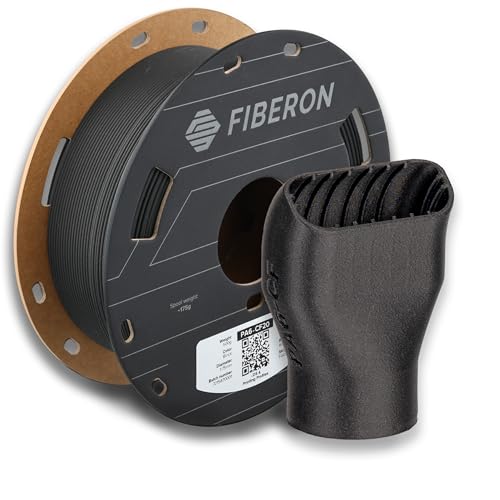
The Polymaker Fiberon PA6-CF20 is the filament to reach for when you need parts that can genuinely take abuse. This spool packs a 20% chopped carbon fiber reinforcement into a PA6 nylon matrix, and the result is a filament that delivers exceptional stiffness, strength, and a heat deflection temperature of 215°C — a number that puts most standard engineering filaments to shame. If you're printing drone frames, bicycle pedals, jigs, or brackets that see real-world stress, this is where you want to be.
What makes the PA6-CF20 stand out beyond its impressive specs is how approachable Polymaker has made it. The Fiberon line was built from the ground up to be compatible with mainstream and entry-level printers, not just professional machines with enclosed heated chambers. That means you're not locked out just because you're running a Bambu Lab X1C or a Prusa MK4 rather than a dedicated industrial rig. Print adhesion between layers is excellent, and the surface finish is clean and uniform — exactly what you want when the part is going into a functional assembly rather than sitting on a shelf.
The warp-free formulation is real. PA6 traditionally has a reputation for warping if you look at it wrong, but Polymaker's engineering here keeps dimensional accuracy tight throughout the print. You will want a hardened nozzle to avoid premature wear from the abrasive carbon fiber, and a dry box or desiccant storage is non-negotiable — nylon absorbs moisture fast. But once you dial in the settings, this filament is a serious performer that earns its spot at the top of this list.
Pros:
- Industry-leading 215°C heat deflection temperature for demanding applications
- Warp-free formulation keeps dimensional accuracy high even on larger prints
- Compatible with most mainstream FDM printers without special enclosures
- Excellent layer adhesion for structural integrity under load
Cons:
- Requires hardened nozzle — carbon fiber will destroy brass quickly
- Nylon base is moisture-sensitive; proper dry storage is essential

2. Polymaker Fiberon PA12-CF10 Nylon Filament — Best for Moisture Resistance
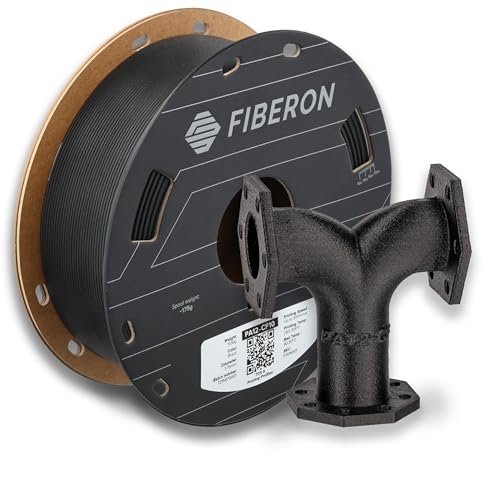
If the PA6-CF20 is the high-temperature powerhouse, the Fiberon PA12-CF10 is the everyday workhorse. PA12 nylon has a fundamentally different moisture absorption profile compared to PA6 — it absorbs significantly less water from the ambient environment, which translates directly to more consistent print quality and better dimensional accuracy in real-world humidity conditions. You get carbon fiber reinforcement with a fraction of the storage headache, making this an ideal choice for workshops without climate control or for makers who don't want to babysit a dry box on every print.
The 10% carbon fiber content is lower than the PA6-CF20, which means the heat deflection temperature comes in at 131°C rather than 215°C. That's still well above what PLA-based options offer, and for most functional parts — enclosures, housings, fixtures, lightweight structural components — it's more than enough. What you gain is a filament that's even more forgiving to print, produces a cleaner surface finish, and handles warp-free across a wide range of part geometries. Polymaker's warp-free technology is baked into this formulation too, so bed adhesion and dimensional stability are reliably strong.
The surface finish on PA12-CF10 prints is notably smooth for a carbon fiber filament. The lower fiber loading means less surface texture and a more refined final appearance. If your parts need to look good as well as perform, this is the better choice over the PA6 variant. Just keep expectations calibrated — you're trading raw thermal performance for printability and moisture resistance, and for many applications, that's exactly the right trade.
Pros:
- Low moisture sensitivity — far more forgiving to store and print than PA6
- Excellent surface finish with cleaner appearance than higher-fiber options
- Warp-free technology delivers reliable dimensional stability
- Compatible with mainstream printers and high-speed printing workflows
Cons:
- 131°C heat deflection temperature lower than PA6-CF20 — not for extreme heat applications
- Still requires a hardened nozzle for long-term use
3. Protopasta Carbon Fiber HT PLA Composite — Best PLA-Based Option
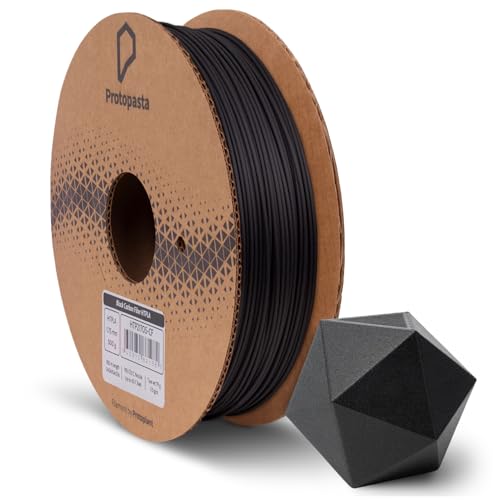
Proto-pasta built a reputation in the maker community for producing filaments that actually do what the marketing says, and the Carbon Fiber HT PLA is a prime example. This is a US-made filament combining milled carbon fibers with high-temperature PLA — the result is a material that's noticeably more rigid than standard PLA, with excellent structural strength and very low warpage. It's the easiest carbon fiber filament on this list to print, making it the natural starting point if you're new to carbon fiber composites.
The surface finish is one of the most distinctive qualities here. Carbon fiber gives the print a beautiful matte black appearance with a subtle sheen that standard black PLA simply can't match. At layer heights under 0.1mm, the layer lines almost disappear into the carbon fiber texture. You can also post-process the prints — shaving or carving with a sharp blade produces a remarkably smooth finish. If aesthetics matter alongside function, this is the filament that delivers both without requiring engineering-grade printer hardware.
Print settings are close to standard PLA, which means most printers handle this without modification. No enclosure required, no exotic bed temperatures, no drying ritual for every session. The "high-temperature" designation means annealed parts resist heat better than regular PLA, pushing thermal performance well beyond standard PLA's limits. For prototyping, display models, or lightly loaded structural parts, this is one of the most satisfying carbon fiber filaments to work with. If you also work with adhesives on your PLA prints, our guide to the best glue for PLA covers the strongest options for bonding carbon fiber PLA parts together.
Pros:
- Easiest to print of all carbon fiber filaments — near-standard PLA settings
- Beautiful matte black finish with subtle carbon fiber sheen
- US-made with consistent quality control and premium materials
- Post-processable — smooth with sharp blade for refined surface
Cons:
- Lower heat deflection than nylon-CF options — not suitable for high-temp applications
- 500g spool size may not be enough for larger print batches
4. ZIRO Carbon Fiber PLA Filament 1.75mm — Best Budget Pick
The ZIRO Carbon Fiber PLA hits a sweet spot that a lot of makers are looking for: solid carbon fiber performance at a budget-friendly price point without the headaches of exotic materials. The 15% carbon fiber loading delivers genuine rigidity improvements over standard PLA, and ZIRO's manufacturing process is tighter than you'd expect at this price — dimensional accuracy is held to ±0.03mm, and the full mechanical wire winding process means tangle-free feeding throughout the spool. This is not a "buy it and hope for the best" filament.
Print behavior is clean. ZIRO designed this formulation to be odor-free during printing, which is a real quality-of-life improvement if you're printing in an enclosed space. Warp resistance is excellent — the carbon fiber content stiffens the part as it cools, reducing the differential shrinkage that causes standard PLA to lift off the bed. The filament is completely dried before vacuum sealing, and ZIRO includes a re-sealable bag to help you maintain that dryness between sessions. It's a thoughtful touch that a lot of budget options skip.
You'll want a hardened or wear-resistant nozzle here — the 15% carbon fiber content is abrasive, and a standard brass nozzle will show measurable wear over time. ZIRO recommends a 0.4mm hardened nozzle, nozzle temperature of 200–220°C, and bed temperature of 50–60°C. Stick to those parameters and you'll get consistent results. The 0.8kg spool size gives you more material per purchase than most competitors at this tier, making the per-gram cost even more competitive. For makers who want to experiment with carbon fiber without a big financial commitment, ZIRO is the clear entry point.
Pros:
- Competitive price point with generous 0.8kg spool size
- Tangle-free mechanical winding and vacuum-sealed for moisture protection
- No odor during printing — great for indoor or enclosed-space use
- Tight ±0.03mm dimensional accuracy for consistent feeding
Cons:
- Still requires hardened nozzle despite budget positioning
- Lower mechanical performance ceiling than nylon-CF options
5. SainSmart ePA-CF Carbon Fiber Nylon Filament — Best for Heavy-Duty Applications
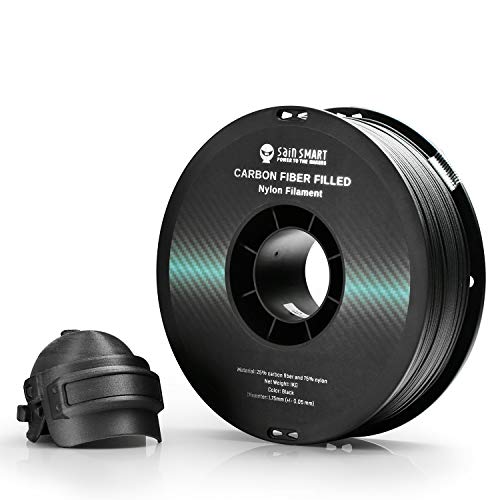
SainSmart's ePA-CF is built for demanding industrial and engineering applications. With an 80/20 nylon-to-carbon-fiber ratio, this filament matches the reinforcement level of the Polymaker PA6-CF20 while coming in on a generous 1kg spool. The 20% carbon fiber loading delivers exceptional rigidity and strength, making it suitable for parts that need to resist torsional, tensile, and impact forces simultaneously. If you're printing replacement components, industrial jigs, or mechanical assemblies, this is a serious contender.
SainSmart's proprietary formula is designed to address the classic weaknesses of nylon-CF: shrink rate is kept deliberately low, and the formulation exhibits less warpage than traditional nylon filaments. The result is higher dimensional accuracy on finished parts, which matters when tolerances are tight. Surface finish is clean and professional, with the characteristic matte texture of carbon fiber composites. Heat resistance and wear resistance are both excellent — this filament holds up under sustained load in ways that PLA-based options simply cannot.
Where you need to be careful is print environment. High-performance nylon-CF materials like this perform best with an enclosure to maintain ambient temperature and reduce thermal stress during the print. Moisture management is also critical — nylon absorbs humidity rapidly, and wet filament produces bubbly, weak prints. SainSmart's new formula reduces this sensitivity somewhat, but a proper drybox setup remains the right approach for best results. At the 1kg size, you get excellent value for serious engineering applications. This is the filament to choose when the part absolutely cannot fail in service. For reference on how carbon fiber reinforced polymers achieve their mechanical properties, Wikipedia's technical overview is a useful primer.
Pros:
- 20% carbon fiber content delivers maximum rigidity and strength in this category
- Lower shrink rate and reduced warpage versus traditional nylon composites
- 1kg spool size delivers excellent value for high-volume printing
- Excellent heat resistance and wear resistance for industrial applications
Cons:
- Enclosure strongly recommended for best results on larger parts
- Moisture-sensitive — dedicated drybox storage is essential
6. ELEGOO PLA-CF Carbon Fiber Filament — Best Dimensional Accuracy
ELEGOO's PLA-CF earns its place on this list through raw precision. The ±0.02mm dimensional accuracy is the tightest tolerance specification among the PLA-CF options reviewed here, and ELEGOO backs it up with consistent real-world performance. If you're printing parts where fit and finish are critical — interlocking assemblies, functional enclosures, or precision fixtures — the tight diameter control means fewer feeding issues and more predictable extrusion behavior print after print.
The carbon fiber reinforcement delivers the mechanical benefits you'd expect: improved strength over standard PLA, better stiffness under load, and reduced flex on thin walls. ELEGOO's formulation also emphasizes layer adhesion, and it shows — delamination is rare even on parts with complex geometries or aggressive overhangs. The surface finish lands exactly where you'd want for a carbon fiber PLA: matte black with a slight texture that reads as premium without being rough to the touch.
The 1kg cardboard spool is a practical choice that keeps packaging waste down, and neatly wound filament means tangle-free feeding from start to finish. ELEGOO has dialed in the feeding consistency carefully, and the combination of tight diameter tolerance and clean winding makes this one of the most trouble-free carbon fiber filaments to run through your printer. For makers who've had frustrating experiences with inconsistent budget carbon fiber filaments in the past, ELEGOO's PLA-CF is a reliable step up that doesn't require nylon-level print complexity. This also pairs well with a reliable monitoring setup — see our review of the best webcam for OctoPrint to keep an eye on long print jobs remotely.
Pros:
- Best-in-class ±0.02mm dimensional accuracy among PLA-CF options
- Strong layer adhesion reduces delamination on complex geometries
- Neatly wound on eco-friendly cardboard spool — consistent tangle-free feeding
- Easy to print — near standard PLA settings, no enclosure required
Cons:
- PLA base limits heat resistance compared to nylon-CF alternatives
- Hardened nozzle still recommended for extended printing sessions
7. SainSmart Carbon Fiber PETG Filament — Best PETG Composite
PETG is already a popular choice for functional parts because it offers better temperature resistance than PLA and better printability than nylon. Add carbon fiber reinforcement and you get a material that's rigid, lightweight, heat-resistant, and abrasion-resistant — with the characteristic PETG advantage of no warping and easy support removal. SainSmart's CF PETG fills a gap in the market for makers who need more than standard PETG can offer but aren't ready to manage the complexity of nylon-CF printing.
The strength and durability of this filament are genuinely impressive for a PETG-based material. SainSmart targets industrial applications ranging from aerospace to motorsports, and while those claims can sometimes be marketing hyperbole, the mechanical properties back up a wide range of demanding use cases. The abrasion resistance is particularly notable — standard PETG can wear down in friction-bearing applications, but the carbon fiber reinforcement significantly improves wear resistance, making this suitable for parts that see repeated contact or sliding motion.
Dimensional accuracy is held to ±0.04mm — slightly wider tolerance than the ELEGOO PLA-CF, but still well within the range needed for functional parts. Warp-free behavior is excellent, which makes it practical for large flat parts that would cause headaches in nylon-based composites. Layer adhesion is clean, and support removal is easy — a genuine advantage of PETG chemistry that carries over into the CF formulation. If you're printing parts for environments that see moderate heat, outdoor exposure, or repeated mechanical stress, this is the carbon fiber filament that covers the widest range of real-world conditions without demanding nylon-level print expertise. If you also work with screen printing for project labels or packaging around your prints, check out our guide to the best screen printing ink for complementary production materials.
Pros:
- Combines PETG printability with carbon fiber strength — best of both worlds
- Excellent warp resistance — practical for large parts without enclosure
- Strong abrasion and wear resistance for friction-bearing applications
- Easy support removal — a key advantage of PETG chemistry
Cons:
- Lower heat deflection ceiling than nylon-CF options for extreme-temperature use
- Carbon fiber content makes it more abrasive than standard PETG — hardened nozzle needed
Choosing the Right Carbon Fiber Filament: A Buying Guide
Base Polymer: The Most Important Choice You'll Make
The carbon fiber in these filaments improves stiffness, strength, and surface finish across the board. But the base polymer determines printability, heat resistance, and moisture behavior — and those differences are dramatic. PLA-CF is the easiest to print. It works on virtually any FDM printer without an enclosure, and the settings are close to standard PLA. PETG-CF adds better temperature resistance and chemical resistance while remaining warp-free and easy to print. Nylon-CF (PA6 or PA12) delivers the best mechanical properties and the highest heat deflection temperatures, but requires more careful handling: moisture management, often an enclosure, and attention to bed adhesion. Match your base polymer to your actual use case — don't over-engineer a part that will sit at room temperature, and don't under-engineer one that will be exposed to heat or load.
Carbon Fiber Percentage: More Isn't Always Better
Higher carbon fiber content increases stiffness but reduces toughness. A 20% CF loading like the SainSmart ePA-CF or Polymaker PA6-CF20 delivers maximum rigidity — ideal for structural members that need to resist deflection. A 10–15% loading like the Polymaker PA12-CF10 or ZIRO CF PLA balances stiffness with improved printability and surface finish. If you're printing parts that absorb impact — enclosures, covers, brackets that may get knocked — a lower CF percentage often performs better in practice because the part flexes slightly before failing rather than fracturing cleanly. High CF content also means higher abrasivity to your nozzle, so factor in consumable costs.
Nozzle and Printer Compatibility
Every carbon fiber filament on this list will destroy a standard brass nozzle over time. The carbon fiber particles act as an abrasive, wearing the nozzle bore into an oval shape that produces inconsistent extrusion. A hardened steel nozzle is the minimum investment — they're inexpensive and last far longer. Ruby-tipped or wear-resistant coated nozzles go further if you print high-CF materials regularly. You also need to verify your printer's Bowden tube or extruder can handle the increased backpressure that comes with carbon-reinforced materials. Direct drive extruders handle CF filaments more reliably than long-path Bowden setups, though most modern Bowden printers manage well if the filament quality is consistent.
Storage and Moisture Management
Carbon fiber filaments range from moisture-tolerant to extremely moisture-sensitive. PLA-CF is the most forgiving — store it reasonably and it prints without issues. PETG-CF sits in the middle. Nylon-CF is the most demanding: PA6 in particular absorbs ambient humidity quickly, and wet nylon-CF prints produce bubbling, stringing, and dramatically weakened parts. A proper drybox or active filament dryer is essential for nylon-CF materials. Print directly from the dryer if possible. Before you load any nylon-CF spool that's been sitting open, dry it at 70–80°C for 8–12 hours. This single step prevents the majority of print failures people experience with high-performance engineering filaments.
Questions Answered
Do I need a special printer to use carbon fiber filament?
You don't need a specialized industrial printer, but you do need a hardened nozzle. Standard brass nozzles wear rapidly with abrasive carbon fiber materials. For PLA-CF and PETG-CF, most modern FDM printers work without modification beyond the nozzle swap. For nylon-CF materials, an enclosure improves results significantly by maintaining ambient temperature and reducing warp. Printers like the Bambu Lab X1C, Prusa MK4, and similar mid-range machines handle carbon fiber filaments well with appropriate settings.
Is carbon fiber filament stronger than regular PLA or PETG?
Carbon fiber filament is significantly stiffer than standard PLA or PETG, meaning it resists bending and deflection better under load. However, stiffness and strength are different properties — high-CF filaments can be brittle under impact compared to unfilled polymers. In tension and compression along the print axis, CF composites excel. For parts that absorb shock or flex repeatedly, standard nylon or PETG may actually outperform their CF counterparts in long-term durability.
What nozzle size should I use for carbon fiber filament?
A 0.4mm hardened steel nozzle is the standard recommendation and works well for most applications. Some makers prefer 0.6mm or larger when printing with high-CF nylon composites, as the larger bore reduces backpressure and nozzle wear rate. Ruby-tipped nozzles are the most wear-resistant option and pay for themselves quickly if you print CF materials regularly. Avoid brass nozzles entirely — you'll see measurable wear within the first few spools.
Does carbon fiber filament need to be dried before printing?
For PLA-CF, drying is helpful but not always critical if the filament was properly sealed. For PETG-CF, drying before use is recommended, especially after the spool has been open for a week or more. For nylon-CF materials — PA6 or PA12 based — drying is non-negotiable. Nylon absorbs moisture rapidly from ambient air, and wet nylon-CF produces bubbling, poor layer adhesion, and significantly reduced mechanical properties. Dry nylon-CF at 70–80°C for 8–12 hours before printing, and print directly from a sealed drybox when possible.
What are the best applications for carbon fiber 3D printing filament in 2026?
Carbon fiber filaments excel in applications where the weight-to-stiffness ratio matters: drone frames, RC vehicle components, bicycle accessories, prosthetic structural components, jigs and fixtures, brackets, handles, and lightweight enclosures for electronics. The high heat deflection of nylon-CF materials makes them suitable for under-hood automotive components and other high-temperature environments. For decorative or display-only parts, standard PLA usually delivers a better surface finish at lower cost — save carbon fiber for parts that earn the material's performance benefits.
Can carbon fiber filament be post-processed or painted?
Carbon fiber PLA and HT PLA (like Protopasta's option) can be sanded, carved with a sharp blade, and primed for painting. The matte black surface takes paint well after light sanding and a primer coat. Nylon-CF surfaces are more difficult to sand smoothly due to fiber exposure, but they can be painted with flexible coatings designed for nylon substrates. PETG-CF sands with moderate effort. Chemical smoothing processes that work on standard PETG don't translate directly to the CF composite formulation, so mechanical finishing is the primary post-processing route for all carbon fiber filaments.
Buy on Walmart
- Polymaker Fiberon PA6-CF20 Carbon Fiber Nylon Filament 1.75m — Walmart Link
- Polymaker Fiberon PA12-CF10 Nylon Filament 1.75mm Black 0.5k — Walmart Link
- Protopasta 3D Printer Filament, PLA Filament 1.75mm, Black C — Walmart Link
- ZIRO Carbon Fiber PLA Filament 1.75mm, CF PLA 3D Printer Fil — Walmart Link
- SainSmart 1.75mm Black ePA-CF Carbon Fiber Filled Nylon Fila — Walmart Link
- ELEGOO Carbon Fiber PLA Filament 1.75mm Black 1KG, PLA-CF St — Walmart Link
- SainSmart Carbon Fiber PETG Filament, 1.75mm 3D Printing Fil — Walmart Link
Buy on eBay
- Polymaker Fiberon PA6-CF20 Carbon Fiber Nylon Filament 1.75m — eBay Link
- Polymaker Fiberon PA12-CF10 Nylon Filament 1.75mm Black 0.5k — eBay Link
- Protopasta 3D Printer Filament, PLA Filament 1.75mm, Black C — eBay Link
- ZIRO Carbon Fiber PLA Filament 1.75mm, CF PLA 3D Printer Fil — eBay Link
- SainSmart 1.75mm Black ePA-CF Carbon Fiber Filled Nylon Fila — eBay Link
- ELEGOO Carbon Fiber PLA Filament 1.75mm Black 1KG, PLA-CF St — eBay Link
- SainSmart Carbon Fiber PETG Filament, 1.75mm 3D Printing Fil — eBay Link
Key Takeaways
- The Polymaker Fiberon PA6-CF20 is the top overall pick in 2026 — 20% carbon fiber content and a 215°C heat deflection temperature make it the benchmark for high-performance engineering applications.
- For beginners or those on a budget, the Protopasta HT PLA-CF and ZIRO CF PLA deliver solid carbon fiber performance with near-standard PLA print settings and no enclosure required.
- The Polymaker PA12-CF10 is the best choice when moisture management is a concern — its low-sensitivity nylon base makes it the most practical nylon-CF option for everyday workshop use.
- Regardless of which filament you choose, a hardened steel nozzle is mandatory — carbon fiber is abrasive to brass, and investing in the right nozzle protects both your hardware and print quality over time.



About Remington May
Remington May is a technology writer and digital product reviewer with a focus on consumer electronics, software, and the everyday tech that shapes how people work and live. She has spent years evaluating smartphones, laptops, smart home devices, and digital tools — approaching each product from the perspective of a practical user rather than a spec-sheet enthusiast. At Pinwords, she covers tech buying guides, product reviews, smartphone and laptop comparisons, and practical how-to guides for getting more out of your devices.
Check for FREE Gifts. Or latest free books from our best messages.
Remove Ad block to reveal all the secrets. Once done, hit a button below