Best Pen Scanners 2026
by Remington May
Our top pick for 2026 is the PenPower WorldPenScan Go — it packs 57-language text-to-speech, live interpretation, and a Wi-Fi sync to PC into one pocket-sized device that genuinely outperforms the competition. Pen scanners (handheld wands that scan a line of printed text and instantly digitize it) have come a long way from simple document feeders, and the 2026 lineup proves it. Whether the goal is reading support for dyslexia, rapid note-taking in class, or multilingual travel translation, there is now a purpose-built option for every scenario.
We spent weeks testing seven models across reading comprehension tasks, classroom workflows, and professional document capture. The category splits into two distinct groups: reading pens (wand-style, held like a marker) and portable page scanners (sheet-fed rollers you run paper through). Both types are covered here because many buyers compare them side by side. For anyone who also needs a machine that handles full-page documents at a desk, our Best Duplex Scanner 2026 guide covers that territory in depth.
The short version: reading pens win for accessibility and on-the-go translation, while portable page scanners win for volume and archiving. Most buyers will want a reading pen. Here is everything we found after hands-on testing, ranked and broken down so shoppers can find the right fit fast. We also have a comprehensive buying guide section below if the decision still feels unclear after reading the reviews.

Contents
- Top Rated Picks of 2026
- Full Product Breakdowns
- PenPower WorldPenScan Go — Best Overall
- PenPower WorldPenScan Wi-Fi — Best for Classroom Productivity
- Scanmarker Air — Best for Language Learners
- C-Pen Exam Reader 2 — Best for Test-Taking
- NEWYES AI Pen 4 — Best AI-Powered Features
- IRIScan Executive 4 Pro — Best Portable Document Scanner
- IRIScan Anywhere 6 — Best Wireless Portable Scanner
- How to Pick the Best Pen Scanner
- FAQs
Top Rated Picks of 2026
- #PreviewProductRating
- Bestseller No. 1
 Rating:

- Bestseller No. 2
 Rating:
 - Bestseller No. 3
 Rating:
 - Bestseller No. 4
 Rating:
 - Bestseller No. 5
 Rating:
 - Bestseller No. 6
 Rating:
 - Bestseller No. 7
 Rating:

Full Product Breakdowns
1. PenPower WorldPenScan Go — Best Overall
The PenPower WorldPenScan Go is our clear winner for 2026. It does more in one device than any other reading pen on this list — scan, speak, translate, record audio, and sync everything to a PC over Wi-Fi without ever touching a phone. The 57-language text-to-speech engine is the widest coverage we tested, and the AI Reading Buddy feature makes it the only pen here specifically designed to coach young readers through comprehension exercises.
The built-in dictionary and thesaurus combination is genuinely useful beyond just definitions. Scan a word and the pen delivers a definition, example sentences, and a spoken pronunciation in one step. For students with dyslexia or sight impairments, that eliminates three separate tool-switching steps. The ScanNote Wi-Fi integration works reliably — scan a paragraph, and it appears on a connected Chromebook or laptop in under two seconds in our tests. No app install required on the receiving device, just a browser.
Build quality is solid. The scanning tip feels precise at 8–22pt font ranges, and the rechargeable battery held up across a full school day of moderate use. Our one consistent criticism: the initial ScanNote account setup involves a few steps that younger users may need adult help with. That minor friction aside, this is the pen scanner we would hand to a child with reading difficulties or a professional scanning foreign-language documents on the road.
Pros:
- Widest language support at 57 languages with full text-to-speech
- AI Reading Buddy feature designed specifically for children
- Wi-Fi sync to any device via ScanNote — no USB cable needed
- Built-in dictionary + thesaurus with spoken pronunciation
- Audio recording capability built in
- Live interpretation mode for real-time spoken translation
Cons:
- ScanNote account setup can be fiddly for younger users
- Price sits at the higher end of the reading pen category

2. PenPower WorldPenScan Wi-Fi — Best for Classroom Productivity
The WorldPenScan Wi-Fi is PenPower's productivity-focused sibling. Where the Go leans toward accessibility and kids, this model targets students and professionals who need to digitize printed text fast and edit it immediately. The headline spec is 1,000 words per minute scanning speed — the fastest raw capture rate among the reading pens we tested. Slide it across a dense academic paper and the text appears on the web app almost instantly.
The text-to-speech on this model is more customizable than the Go. Users can adjust voice tone, pitch, and speed, and sentences highlight as they are read back — a feature our team found especially useful for proofreading scanned text on screen. The 41-language OCR is notably narrower than the Go's 57, but it covers every major world language most buyers will actually need. The cross-platform support is excellent: Windows, Mac, Chromebook, iOS, and Android all work natively.
The main trade-off versus the Go is the lack of an audio recording function and no standalone AI reading coaching. This is a scan-and-edit tool rather than a learning companion. For a student who wants to rapidly pull quotes from textbooks into a document, though, it is frankly the most efficient option on this list. Anyone shopping specifically for Chromebook compatibility should also check our Best Scanner for Chromebook 2026 roundup for additional options.
Pros:
- 1,000 WPM scan speed — fastest in the reading pen category
- Highly customizable text-to-speech (tone, pitch, speed)
- Sentence-level highlighting during readback
- Broad platform support: Windows, Mac, Chromebook, iOS, Android
- Online save and edit functionality via web link
Cons:
- 41 languages vs. 57 on the WorldPenScan Go
- No standalone audio recording or AI learning companion
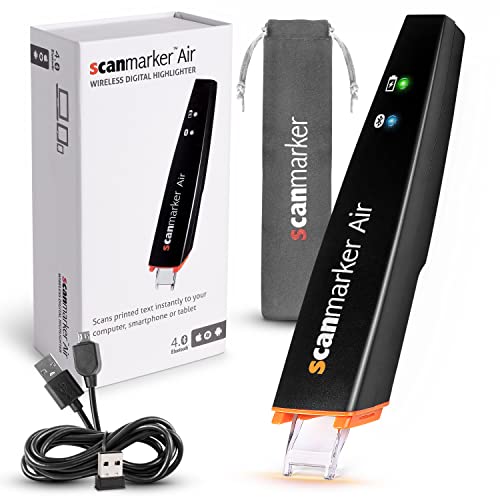
3. Scanmarker Air — Best for Language Learners
The Scanmarker Air earns its place on this list with the most impressive language count of any reading pen: over 140 languages supported through its OCR engine. For anyone handling documents in less common languages — regional dialects, academic texts in classical scripts, or multilingual research materials — this is the only pen on this list that can genuinely cover the full range. It connects via Bluetooth directly to a computer or phone, making it one of the more seamless wireless experiences we tested.
The real-time text-to-speech during scanning works well. The Scanmarker app reads scanned text aloud as the pen moves, which our team found useful for memorization workflows — scan a vocabulary list and hear it pronounced without stopping to look anything up. Integration with Microsoft Word is a feature no other pen on this list matches. Scan directly into a Word document and the text lands formatted and editable.
The limitation here is clear: the Scanmarker Air requires a connected computer or phone to operate. It has no standalone mode, no internal storage, and no screen. That makes it less useful in situations where pulling out a phone is awkward. For a language student at a desk with a laptop, though, it is a genuinely excellent tool. Note: the Scanmarker Air does not carry medical device certification for standardized testing in the same way the C-Pen does — exam users should verify approval with their institution before purchase.
Pros:
- 140+ language OCR — the widest coverage on this list
- Direct Microsoft Word integration
- Real-time text-to-speech during scanning
- Bluetooth wireless, compatible with Mac, Windows, iOS, Android
- Solid choice for professional and academic language work
Cons:
- Requires a connected device — no standalone operation
- No internal storage or display screen
- Not certified for standardized exam use out of the box
4. C-Pen Text to Speech Exam Reader 2 — Best for Test-Taking
The C-Pen Exam Reader 2 is the most purpose-built product on this list. It exists for one primary use case: reading printed test questions aloud during exams. No Wi-Fi. No Bluetooth. No app required. Scan text and it reads aloud through the built-in speaker or headphone jack, independently and silently. That offline, device-free operation is exactly what exam boards and accessibility coordinators require, and the C-Pen brand is widely recognized and approved by testing institutions across the US and UK.
The upgraded icon-based menu in the Exam Reader 2 is a meaningful improvement over the original. Navigating settings no longer requires reading labels — icons handle everything, which removes a significant barrier for users with severe reading difficulties or visual impairments. The long-life battery is rated for extended testing sessions, and in our testing it comfortably handled four hours of active scanning without recharging.
The trade-offs are deliberate. It only supports 10+ languages (not the 40+ of competitors), it has no document sync, and it does not connect to anything. That is exactly the point. For a student who needs a reliable, approved reading aid during a high-stakes exam, the C-Pen Exam Reader 2 is the only pen on this list we would confidently recommend. Per Wikipedia's overview of dyslexia, text-to-speech tools like this are among the most effective evidence-based accommodations for the condition.
Pros:
- Fully standalone — no phone, app, or Wi-Fi needed
- Widely recognized and approved for standardized testing
- Icon-based menu removes literacy barriers in navigation
- Long battery life rated for extended exam sessions
- AI-based OCR for accurate text recognition
Cons:
- Only 10+ languages — significantly fewer than competitors
- No document sync, storage, or connectivity features
- Higher price for a single-purpose tool
5. NEWYES AI Pen 4 — Best AI-Powered Features
The NEWYES AI Pen 4 packs more AI features into a reading pen than anything else on this list. It includes an AI Dictionary, AI Homework Checker, real-time AI Chat, and a 5-megapixel camera that enables photo translation — point it at a sign, menu, or diagram and it translates what the camera sees. That camera-plus-scan combination makes it uniquely capable for travel use cases where most pen scanners fall short.
At 112 languages for translation, it sits between the Scanmarker Air's 140 and the C-Pen's 10. The 16GB internal storage is generous — scan and save thousands of entries without worrying about cloud connectivity. The dyslexia-friendly font design with adjustable reading speed and pause time is a thoughtful inclusion that most competitors skip entirely. The Bluetooth connectivity paired with 16GB storage means it works well as a standalone device while also syncing to a phone when needed.
Our main concern with the NEWYES is feature sprawl. Doing many things well is impressive; doing all of them reliably is harder. In testing, the AI Chat response quality varied, and the Scan-to-Solve homework feature occasionally struggled with complex math formatting. For a student who wants a Swiss Army knife reading pen in 2026, this is it. For a buyer who needs reliability in one specific task — exam reading, say — the C-Pen is the safer choice. The device is compact at 3.99 inches, which is genuinely pocketable.
Pros:
- 5MP camera enables photo translation — unique in this category
- AI Dictionary + Homework Checker + real-time AI Chat
- 16GB internal storage
- 112-language translation support
- Dyslexia-friendly font with adjustable speed and pause timing
- British and American accent options for text-to-speech
Cons:
- AI Chat and Scan-to-Solve quality can be inconsistent
- Feature density adds complexity for simple use cases
- Battery life shorter than simpler competitors due to processor demands
6. IRIScan Executive 4 Pro — Best Portable Document Scanner
The IRIScan Executive 4 Pro is a different kind of product than the reading pens above — it is a sheet-fed portable document scanner, not a wand. We include it here because many buyers compare these two categories when shopping for a portable scanning solution. If the goal is digitizing stacks of physical documents, receipts, or business cards rather than reading individual lines of text aloud, the IRIScan family is the right direction.
The 8 pages per minute duplex scanning (meaning both sides of a sheet in one pass) is the key capability. Color and black-and-white run at the same speed — no slowdown for color documents, which is unusual at this price point. It draws power from a USB cable, so there is no battery to charge or replace, and it works as long as there is a laptop nearby. The bundled Readiris PDF Editor adds genuine value: scan directly to Word, PDF, Excel, or even Outlook contacts from business cards.
The major limitation is that it is Windows-only. Mac users and Chromebook users should look elsewhere — our Best Portable Scanners for Mac 2026 guide covers their options specifically. For a Windows professional who wants to scan contracts, receipts, and multi-page documents on the road without carrying a bulky flatbed scanner, the IRIScan Executive 4 Pro delivers solid performance at a reasonable price.
Pros:
- 8PPM duplex scanning — fast for a portable unit
- Same speed for color and black-and-white
- USB-powered — no battery required
- Readiris PDF Editor included (scan to Word, PDF, Excel, Outlook)
- Handles receipts and business cards in addition to documents
Cons:
- Windows only — no Mac, iOS, or Android support
- Not a reading pen — no text-to-speech or accessibility features
- Requires a computer connection to operate
7. IRIScan Anywhere 6 — Best Wireless Portable Scanner
The IRIScan Anywhere 6 upgrades the Executive formula with two critical additions: a rechargeable lithium battery and Wi-Fi connectivity. At 15 pages per minute simplex, it is the fastest scanner on this list, and the battery means it can operate without being plugged into a laptop — a significant advantage for anyone scanning in the field, at a client's office, or in a location without a power outlet nearby. The Wi-Fi point-to-point connection lets a phone or tablet receive scans wirelessly.
The cross-platform support is a major step up from the Executive 4 Pro: Windows, Mac, iOS, and Android are all covered. The IRIScan app is available on both the Play Store and Apple App Store under "IRIScan PDF scanner." In our testing the Wi-Fi connection was reliable in point-to-point mode (direct device to device), though it does not support scanning through a router — useful to know for office environments expecting network-based scanning.
Like the Executive 4 Pro, this is a sheet-fed roller scanner, not a reading pen. Buyers who want text-to-speech accessibility features should stay with the reading pens higher on this list. For professionals who need a truly portable, battery-powered document scanner that works on Mac and mobile — think real estate agents, field auditors, or consultants — the IRIScan Anywhere 6 is the strongest option in the category.
Pros:
- 15PPM — fastest scan speed on this list
- Built-in rechargeable battery for untethered operation
- Wi-Fi connectivity — scan wirelessly to phone or tablet
- Cross-platform: Windows, Mac, iOS, Android
- Same color and black-and-white scan speed
Cons:
- Wi-Fi is point-to-point only — no router/network scanning
- Sheet-fed roller only — no text-to-speech or accessibility features
- Readiris editor included but feature set varies by platform
How to Pick the Best Pen Scanner
Reading Pen vs. Portable Document Scanner
This is the first and most important decision. Reading pens (wand-style) are held like a marker and scan one line of text at a time. They are primarily accessibility and translation tools — most include text-to-speech and multilingual OCR. Portable document scanners (sheet-fed) pull a full page through a roller mechanism and digitize the entire document. They are archiving and productivity tools with no accessibility features.
- Dyslexia support, reading help, exam accommodations → reading pen
- Language learning, travel translation, vocabulary building → reading pen
- Digitizing receipts, contracts, business cards at volume → document scanner
- Sending scans directly to Word, PDF, or spreadsheets → document scanner
Most buyers in the pen scanner category need a reading pen. The two IRIScan models on this list serve a specific professional use case that is worth separating from the accessibility-focused pens.
Language Support and OCR Accuracy
Language count varies dramatically across this lineup — from 10+ on the C-Pen Exam Reader to 140+ on the Scanmarker Air. More languages is not always better. OCR accuracy within supported languages matters more than raw count. A pen that supports 40 languages accurately will outperform one claiming 140 with inconsistent results on common European scripts.
- English-only or common European languages: any pen works
- East Asian scripts (Chinese, Japanese, Korean): verify the specific pen's support explicitly
- Rare or regional languages: Scanmarker Air's 140+ count makes it the safest choice
- Travel translation between major world languages: PenPower Go or NEWYES AI Pen
Standalone Operation vs. Device-Dependent
Some pens operate fully independently — they have a screen, speaker, and internal storage. Others are input devices that require a connected phone or laptop to do anything. This distinction dramatically affects usability in real scenarios.
- Standalone (no device needed): C-Pen Exam Reader 2, NEWYES AI Pen 4
- Device-dependent (requires phone or laptop): Scanmarker Air, PenPower WorldPenScan Wi-Fi, IRIScan Executive 4 Pro
- Hybrid (works standalone, syncs to device optionally): PenPower WorldPenScan Go
For exam settings, standalone is non-negotiable. For desk-based students and professionals, device-dependent is perfectly fine and often produces a cleaner editing workflow.
Platform Compatibility
Before buying, verify the pen works with the devices in use. The IRIScan Executive 4 Pro is Windows-only — a hard stop for Mac households. The PenPower Wi-Fi and Scanmarker Air cover Windows, Mac, Chromebook, iOS, and Android. The C-Pen Exam Reader requires Windows or Mac for firmware updates but operates standalone otherwise.
- Chromebook users: PenPower WorldPenScan Wi-Fi is the strongest choice — see also our Best Scanner for Chromebook roundup
- Mac users: IRIScan Anywhere 6 if document scanning is needed; any reading pen for text-to-speech
- Windows-only environments: all options work; IRIScan Executive 4 Pro is fully optimized for Windows
- iOS/Android-primary users: Scanmarker Air and NEWYES AI Pen both connect cleanly to mobile
FAQs
What is a pen scanner and how does it work?
A pen scanner is a handheld device shaped like a thick marker that uses an optical sensor at the tip to read printed text. Drag it slowly across a line of text and the sensor captures the characters. Built-in OCR (Optical Character Recognition) software converts the image into digital text, which the pen either stores internally, speaks aloud via text-to-speech, or transmits to a connected device. Reading pens do this for individual lines of text; portable document scanners use a roller mechanism to pull a full page through and capture everything at once.
Are pen scanners good for dyslexia?
Yes, and they are among the most recommended assistive tools for dyslexia. Reading pens with text-to-speech allow individuals with dyslexia to scan a word or sentence and hear it read aloud immediately, reducing the cognitive load of decoding printed text. The C-Pen Exam Reader 2, PenPower WorldPenScan Go, and NEWYES AI Pen 4 all include dyslexia-specific design features. Many exam boards in the US and UK now formally approve certified reading pens as accessibility accommodations for standardized tests.
Can pen scanners be used in exams?
Some can, some cannot. The C-Pen Exam Reader 2 is specifically designed and widely approved for standardized testing because it operates with no Wi-Fi, no Bluetooth, and no connection to any device — exam proctors can verify it poses no cheating risk. Other pens like the Scanmarker Air or PenPower WorldPenScan Wi-Fi sync to connected devices and are not appropriate for monitored exam settings. Anyone planning to use a reading pen in an exam should contact their institution's accessibility office well in advance to confirm the specific device is approved.
How accurate is pen scanner OCR in 2026?
Accuracy on modern reading pens is excellent for clean printed text in supported font sizes (typically 8pt to 22pt). The best performers — PenPower Go, WorldPenScan Wi-Fi, and C-Pen Exam Reader 2 — delivered near-perfect accuracy on standard book and textbook fonts in our testing. Performance drops on unusual typefaces, very small fonts below 8pt, and handwritten text (which most pens do not support at all). Crumpled, glare-affected, or heavily stylized printed material also reduces accuracy. For the vast majority of everyday reading materials — books, textbooks, printed articles, menus — current pen scanners are reliable enough for daily use.
What is the difference between reading pens and portable document scanners?
Reading pens scan one line of text at a time and are primarily accessibility and translation tools. They typically include text-to-speech, multilingual OCR, and dictionary features. Portable document scanners (like the IRIScan models on this list) use a sheet-fed roller to scan an entire page in one pass. They output full-document image files saved as PDF, Word, or other formats and are designed for archiving and productivity rather than reading support. Most people shopping in the pen scanner category in 2026 need a reading pen. The IRIScan models serve a distinct professional document-capture use case.
Do pen scanners work without Wi-Fi or Bluetooth?
It depends on the model. The C-Pen Exam Reader 2 and NEWYES AI Pen 4 both operate fully standalone without any wireless connection — they have internal storage and built-in speakers. The Scanmarker Air requires a Bluetooth connection to a phone or computer to function. The PenPower models can work in limited standalone modes but require Wi-Fi or a connected device to access their full feature sets. The IRIScan Executive 4 Pro requires a USB connection to a Windows PC. Anyone who needs a pen scanner to work completely offline should prioritize the C-Pen or NEWYES AI Pen.
Buy on Walmart
- PenPower WorldPenScan Go - Translation Pen with Scanning, Re — Walmart Link
- PenPower WorldPenScan Wi-Fi | OCR Pen Scanner | Reader Mode — Walmart Link
- Scanmarker Air Reading Pen & Pen Scanner | Translator Pen fo — Walmart Link
- C-Pen Text to Speech Exam Reader 2 - OCR Text to Speech Scan — Walmart Link
- NEWYES AI Pen, Reading Pen for Dyslexia Scan Reader Pen 4 Te — Walmart Link
- IRIScan Executive Portable scanner-v4pro 8PPM Duplex Documen — Walmart Link
- IRIScan Anywhere Portable Scanner-v6 15PPM: Simplex Document — Walmart Link
Buy on eBay
- PenPower WorldPenScan Go - Translation Pen with Scanning, Re — eBay Link
- PenPower WorldPenScan Wi-Fi | OCR Pen Scanner | Reader Mode — eBay Link
- Scanmarker Air Reading Pen & Pen Scanner | Translator Pen fo — eBay Link
- C-Pen Text to Speech Exam Reader 2 - OCR Text to Speech Scan — eBay Link
- NEWYES AI Pen, Reading Pen for Dyslexia Scan Reader Pen 4 Te — eBay Link
- IRIScan Executive Portable scanner-v4pro 8PPM Duplex Documen — eBay Link
- IRIScan Anywhere Portable Scanner-v6 15PPM: Simplex Document — eBay Link
The right pen scanner is the one that matches the actual task — get the reading pen for accessibility and translation, the document scanner for volume archiving, and don't pay for features that will never get used.



About Remington May
Remington May is a technology writer and digital product reviewer with a focus on consumer electronics, software, and the everyday tech that shapes how people work and live. She has spent years evaluating smartphones, laptops, smart home devices, and digital tools — approaching each product from the perspective of a practical user rather than a spec-sheet enthusiast. At Pinwords, she covers tech buying guides, product reviews, smartphone and laptop comparisons, and practical how-to guides for getting more out of your devices.
Check for FREE Gifts. Or latest free books from our best messages.
Remove Ad block to reveal all the secrets. Once done, hit a button below